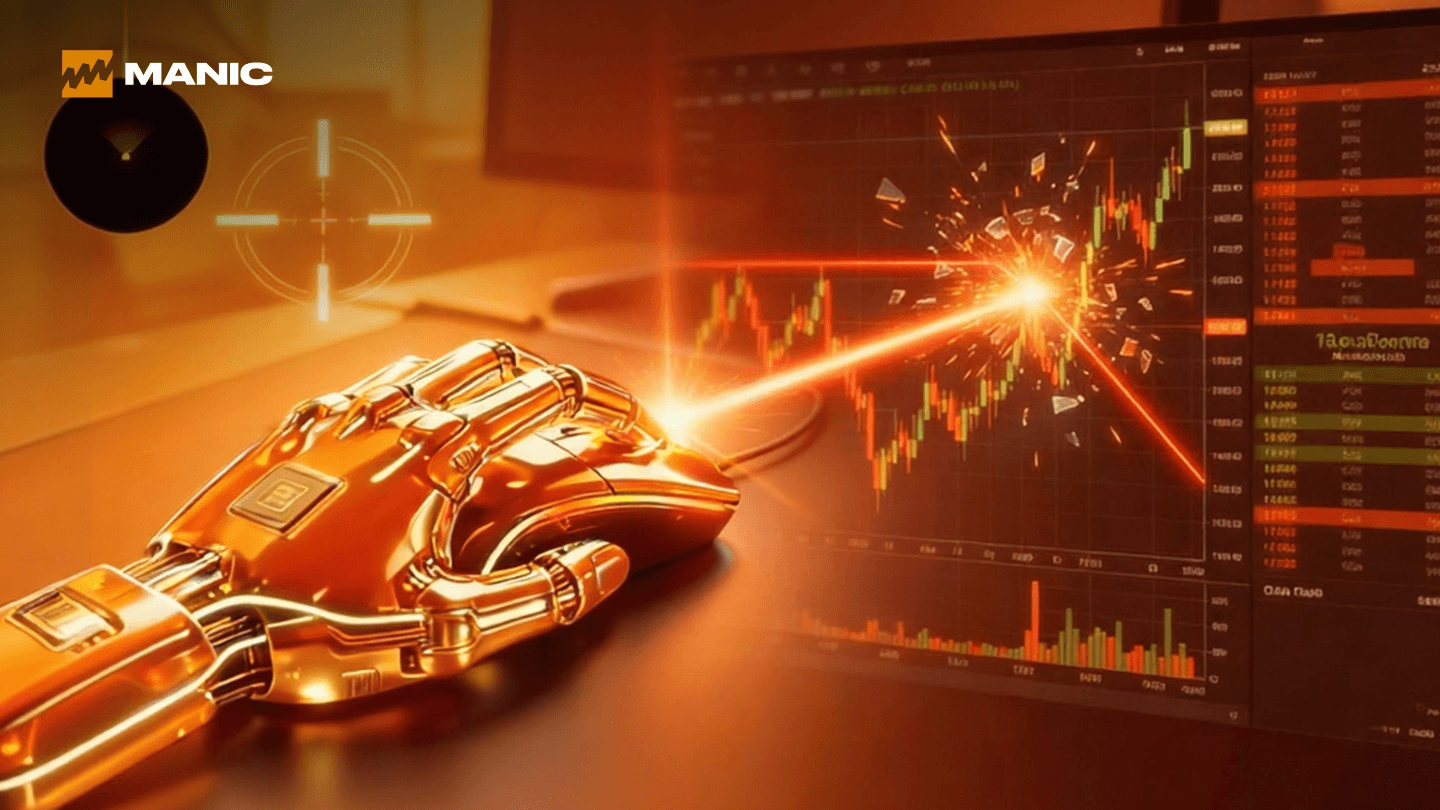
Is gaming helpful for crypto trading? Yes. The cognitive skills developed in competitive gaming (e-sports) — specifically sub-second reaction times, spatial awareness, and high-speed pattern recognition — are directly transferable to high-frequency crypto scalping. While a finance degree teaches you to analyze value, FPS skills train you to execute decisions under pressure, which is the deciding factor in 1-minute trading intervals.
Stop me if this sounds familiar.
Stop me if this sounds familiar.
Your heart rate spikes. Your pupils dilate. The world narrows down to a single focal point on your screen. You aren’t thinking about your grocery list or your rent. You are purely reacting. A pixel moves, and your finger clicks. Headshot.
Now, tell me: How is this different from scalping a 1-minute candle on Solana?
It isn’t.
For decades, Wall Street (“The Suits”) tried to convince us that trading requires a PhD in Economics, three monitors displaying Bloomberg Terminals, and an understanding of macroeconomic theory.
They were lying.
In the high-velocity world of modern crypto scalping, financial analysis is too slow. By the time an analyst calculates the P/E ratio, the move is over. Today, the market doesn’t belong to the analysts. It belongs to the Gamers.
Here is why your thousands of hours in Counter-Strike, League of Legends, or Call of Duty make you a more dangerous trader than a Harvard grad.
1. The OODA Loop: Why Speed Kills
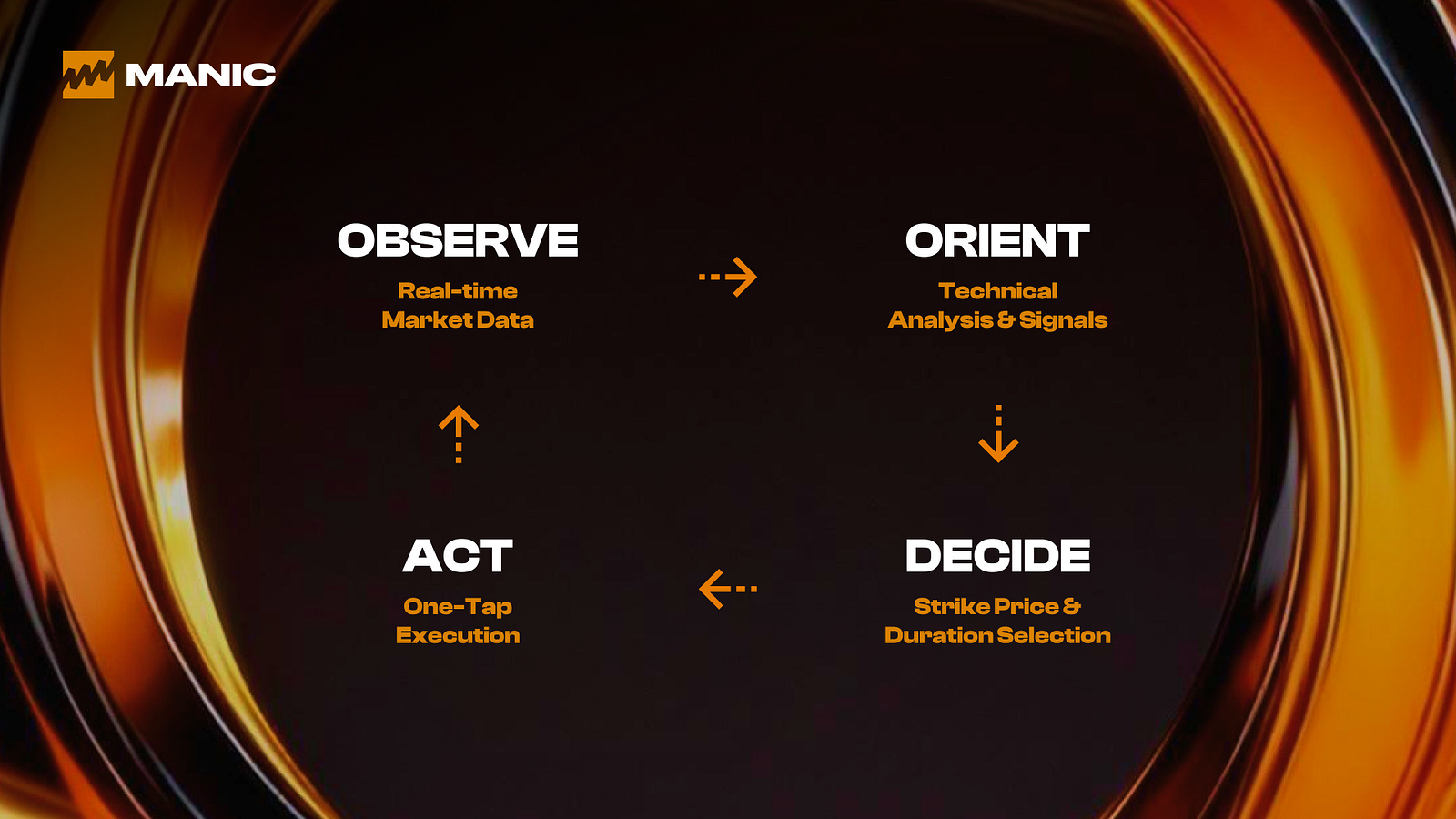
In military strategy (and competitive gaming), there is a concept called the OODA Loop:
- Observe (See the enemy)
- Orient (Process the position)
- Decide (Choose the shot)
- Act (Click)
The winner isn’t the one with the best plan; it’s the one who cycles through this loop faster.
In a 1v1 duel, if your reaction time is 200ms and your opponent’s is 400ms, you win. Every time. The same logic applies to Momentum Trading. When a price “Squeeze” breaks out, the window to enter is often less than 3 seconds.
- The Analyst is stuck in the “Orient” phase, checking his RSI and MACD indicators (which lag behind reality).
- The Gamer sees the visual movement (Observe) and instinctively hits the button (Act).
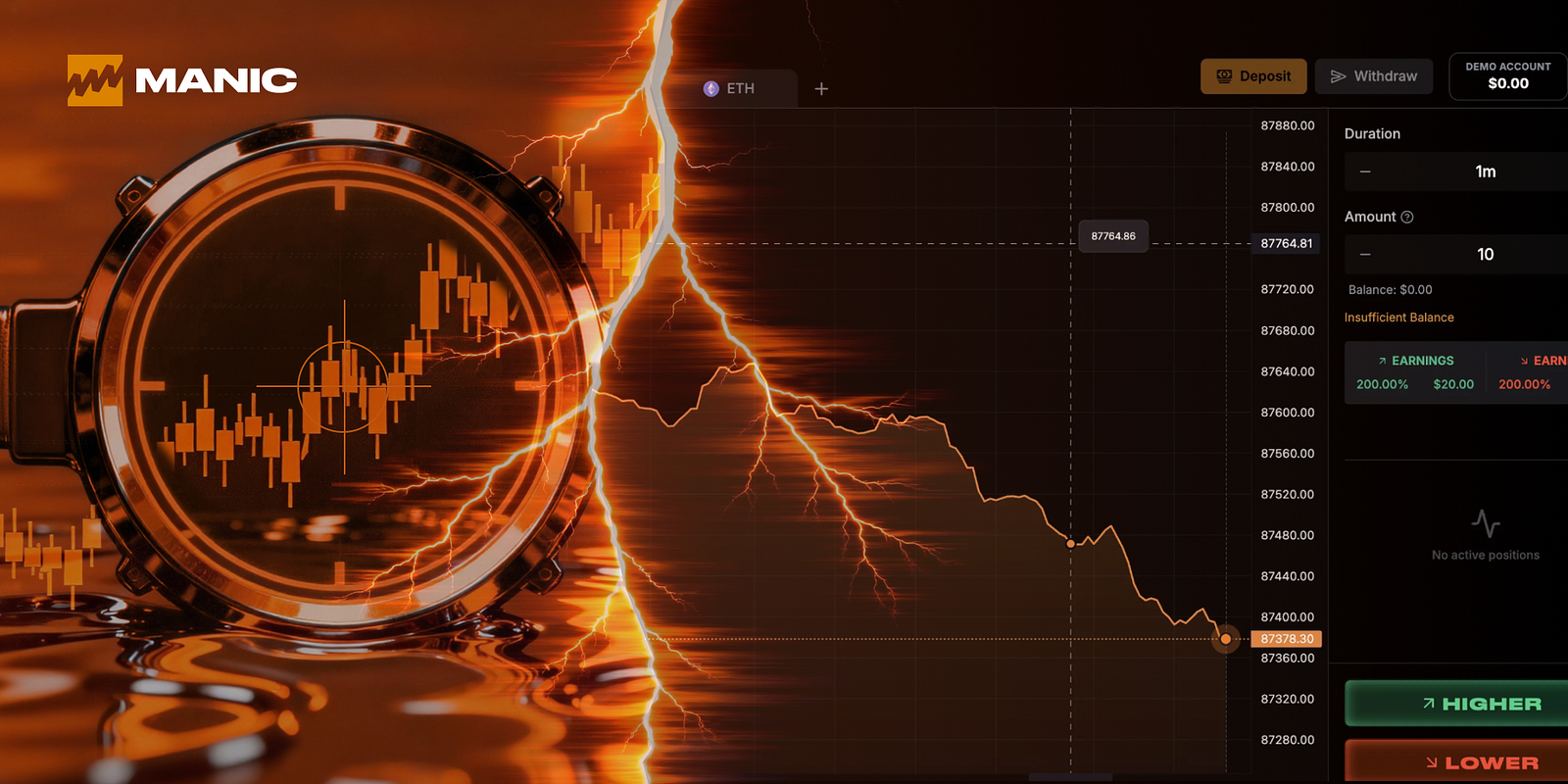
Manic Trade was built specifically to tighten this loop. We removed the “Confirm Order” pop-ups. We removed the loading spinners. Why? Because in gaming, we call that “Input Lag.” And input lag gets you killed.
Learn more about the
2. APM (Actions Per Minute) vs. Analysis Paralysis
In RTS games like StarCraft, players are measured by APM. High APM means your brain is wired directly to your hands.
Traditional trading platforms are designed for low APM. They are clunky. They ask you twenty questions before letting you open a position. They induce “Analysis Paralysis” — the state of overthinking until the opportunity vanishes.
On Manic, we treat trading like an esport.
- Visual Clarity: No clutter. Just the price action.
- Mechanics: One click to enter. One click to exit. Instant settlement.
You don’t need to know why Solana is moving up. You just need the mechanical skill to catch the wave. Your “muscle memory” from gaming — the ability to react to visual stimuli without conscious thought — is your greatest edge.
3. Entering “The Flow State”
You know that feeling when you’re 10 rounds into a match, you’re top fragging, and you can’t miss? You are in “The Zone” (psychologically known as the Flow State).
In this state, time distorts. You aren’t “trying” to play; you are the game.
Trading requires this same state. Distractions are the enemy. Complex indicators are distractions. News feeds are distractions. To trade high-frequency momentum, you need to strip away the UI until it’s just you and the chart. This is why we design for Cognitive Minimalism.
If your trading interface looks like the cockpit of a Boeing 747, you can’t flow. You’re just a pilot reading manuals while the plane is crashing.
External Reading:
4. The “Camper” Mindset (Patience)
Gamers get a bad rap for “camping,” but in trading, camping is a strategy.
A sniper doesn’t run into the middle of the map spraying bullets. They find a position. They wait. They watch for movement. They hold… hold… hold… SNAP.
This is exactly how you trade Visual Volatility.
- You don’t trade when the market is chopping sideways (boring mid-map).
- You wait for the “Squeeze” (the enemy walking into your crosshairs).
- You execute with zero hesitation.
If you have the patience to hold an angle in Valorant for 45 seconds, you have the patience to scalp crypto.
Conclusion: Transfer Your Skills
The market is no longer a place for guys in suits shouting on floor phones. It is a digital arena. It is PVP (Player vs. Player).
You have spent years training your eyes to spot movement. You have trained your fingers to react in milliseconds. You have trained your brain to handle pressure.
Why are you letting the “Suits” tell you that you aren’t qualified?
You are the algorithm. Drop the lag. Join the lobby.
🌐 Official Website:Start Your Match on Manic.Trade
🐦 X (Twitter): @ManicTrade
🎮 Discord: Join the Server
✈️ Telegram: Official Channel
Key Takeaways for “Gamer Trading Strategy”:
- Reaction Time over Analysis: Momentum trading prioritizes reaction speed (OODA Loop) over fundamental analysis.
- Flow State: Successful scalpers minimize cognitive load to maintain psychological “flow,” similar to competitive esports.
- Zero-Friction Execution: Platforms like Manic Trade eliminate input lag (pop-ups, slow settlement) to enable high-APM trading strategies.
- Visual Price Action: Gamers use visual pattern recognition to spot price “squeezes” instead of relying on lagging technical indicators.
Related Reading
This article is part of our comprehensive guide: Trading Psychology for High-Frequency Scalping: The Complete Mental Discipline Guide.
Discover why 90% of scalpers fail psychologically, the 5 core mental traps destroying traders, and the architectural solutions that eliminate discipline failure without relying on willpower.