Comparing Polymarket vs Kalshi in 2026 comes down to one question: are you trying to trade event outcomes or are you trying to speculate on short-term crypto price moves?
Both platforms let users express directional views, but they are built around different structures. Kalshi is a US-regulated event market. Polymarket is a crypto-native prediction platform with broader market framing and different access tradeoffs.
For many users, the biggest mistake is treating this as a simple “which one is better?” question. The better question is which platform matches your use case, constraints, and trading style.
Is Polymarket or Kalshi better?Kalshi is generally the better fit for users who want a regulated US event market. Polymarket is often the better fit for users who prefer a crypto-native prediction market experience. Neither platform is ideal for traders who primarily want to trade short-term BTC, ETH, or SOL price direction.
Quick comparison:
- Best for regulated US event trading: Kalshi
- Best for crypto-native event markets: Polymarket
- Best for short-term crypto price direction: neither; that is a different category
📊 Quick Takeaways
The Confusion: Traders searching for crypto prediction tools land on Polymarket and Kalshi because both use probability language. But 78% of those traders are actually looking for price direction tools — not event outcome markets.
The Reality Check:
- ✅ Polymarket — Binary event outcomes (will X happen by date Y?). Settles in days to months. Best for macro event bets (elections, regulatory decisions).
- ✅ Kalshi — US-regulated event contracts. CFTC-approved, KYC required. Same event-resolution model.
- ✅ Neither — Designed for sub-minute crypto price trading. No pattern recognition edge applies.
- ✅ The gap — There's a distinct category of platforms built specifically for crypto price direction at execution speed. That's where momentum scalpers actually belong.
Real Impact: A trader misallocating their edge to event betting instead of crypto price direction trading loses not just ROI — they lose the compounding speed advantage that comes from 400ms Solana settlement vs multi-day event resolution.
Read time: 11 minutes | Decision: Which platform type fits your actual strategy?
Introduction: The Comparison That Misleads
In April 2024, Polymarket attracted headlines when Iranian missile strikes against Israel sent prediction market volumes surging. Traders rushed to bet on escalation probabilities. The markets moved fast. The interface felt like trading.
But here's what actually happened on the backend: those contracts wouldn't resolve until the "event" — defined by specific criteria like Israeli military response — was officially confirmed by Polymarket's UMA oracle system. Some traders held positions for 72+ hours. Others saw their capital locked while crypto markets moved 15% in unrelated momentum.
Event betting and price trading look identical on the surface. The settlement mechanics are completely different.
This matters because if you're comparing Polymarket to Kalshi to decide where to trade crypto, you're optimizing for the wrong variable. You're choosing between two restaurants because they both have menus — without checking whether either of them serves the food you actually want.
The traders who get this distinction right early stop losing time, capital, and edge to misaligned platform choices.
What Polymarket Actually Is (And What It's Not)
Polymarket is a decentralized prediction market running on Polygon blockchain. You buy YES/NO contracts on binary questions:
- "Will ETH hit $5,000 before June 2026?"
- "Will the Fed cut rates in Q2 2026?"
- "Will Trump sign a crypto executive order by July?"
Each contract resolves at $1 (YES wins) or $0 (NO wins) when the event outcome is confirmed. The resolution mechanism uses UMA's Optimistic Oracle — a dispute-resolution system that relies on human verification with a 48-hour challenge window.
Strengths:
- No KYC required (Polygon wallet connection)
- High liquidity on major political/macro events
- Transparent on-chain markets
- Works well for macro event positioning
What it cannot do:
- Resolve in seconds or minutes (oracle minimum: 48 hours)
- Give you edge on technical chart patterns
- Provide sub-minute execution for scalping
- React to SOL/USD moving 2% in 90 seconds
The critical limitation: Polymarket's oracle dependency means your capital is locked from the moment you enter until the event resolves. In crypto scalping terms, that's 48 hours to weeks of dead capital.
The oracle architecture gap between Polymarket (UMA, 48-hour resolution) and Kalshi (centralized, off-chain) becomes clearer when you trace both back to their shared predecessor. The Augur vs Gnosis vs Polymarket architecture breakdown explains why all three generation share the same event-contract DNA.
What Kalshi Actually Is (And Why It's Even More Constrained for Crypto Traders)
Kalshi is the regulated version of the same concept. It's CFTC-approved, operates in the US, and runs event contracts on economic and political outcomes:
- "Will CPI exceed 3% in March 2026?"
- "Will the US enter recession by Q3 2026?"
- "Will any crypto bill pass by December 2026?"
The regulation brings real advantages for certain users — institutional legitimacy, FDIC-insured cash holdings, legal clarity. But for crypto momentum traders, the regulatory framework adds friction that makes it even less suited to your use case.
Kalshi's constraints for crypto scalpers:
| Feature | Kalshi | Crypto Price Trader's Need |
|---|---|---|
| KYC Required | Yes (ID verification, 1-3 days) | ❌ Needs wallet-connect instant access |
| Event Resolution | Days to months | ❌ Needs sub-second settlement |
| Asset Focus | Macro events, regulation outcomes | ❌ Needs SOL/USD price direction |
| Leverage | No | ❌ Needs risk/reward scaling |
| Pattern Edge | N/A (binary event outcome) | ❌ Needs technical setup recognition |
| Trade Frequency | 1-5 positions per event cycle | ❌ Needs 10-50 trades per session |
Verdict: Kalshi is excellent if you're a macro trader wanting regulated event exposure. It is the wrong tool if you want to scalp crypto price momentum.
The Iran Attack Moment: Why Trust in Event Markets Cracked
In April 2024, when Iran launched drone and missile strikes against Israel, Polymarket saw its highest single-day volume at that point. Hundreds of traders rushed to bet on "Will Israel retaliate militarily?" and "Will Iran attack again within 30 days?"
What followed exposed the fundamental weakness of event betting for active traders:
The oracle problem: Polymarket's UMA oracle requires human verification of event outcomes. Disputes take 48 hours minimum. When geopolitical events are ambiguous — and they almost always are — resolution timelines slip. Some positions in that April cycle sat unresolved for over a week while market conditions changed entirely.
The capital lock: Traders with capital deployed in Polymarket event contracts couldn't redeploy into the crypto price moves that followed. BTC dropped 8% then recovered 12% over the next 10 days — a clear momentum trading opportunity. Their capital was frozen waiting for oracle resolution.
The information asymmetry: Event markets work best for participants with superior information on the event itself (political insiders, intelligence analysts). Crypto technical traders have information advantage on price structure and momentum — not geopolitical escalation timelines.
The lesson: Event betting platforms reward a fundamentally different information edge than price trading platforms. Conflating them doesn't double your edge — it divides it.
The Decision Framework: Which Platform Type Actually Fits You
| Your Trading Goal | KYC Preference | Timeframe | Platform Match | Verdict |
|---|---|---|---|---|
| Bet on whether X event happens | No KYC | Days to months | Polymarket (Polygon wallet, no ID) | ✅ Event market fit |
| Bet on whether X event happens | KYC acceptable (US) | Days to months | Kalshi (CFTC regulated) | ✅ Regulated event market |
| Trade crypto price direction | No KYC | Minutes to hours (scalping) | Solana-based execution platforms | ✅ Price direction fit |
| Trade crypto price direction | KYC acceptable | Days to weeks (swing) | CEX futures or options | ⚠️ Slower execution |
| Trade crypto price direction | Any | Sub-second scalping | 400ms settlement, pattern-based | ✅ Momentum trader fit |
The honest question to ask yourself:
When you searched "Polymarket vs Kalshi," what were you actually trying to find? If your answer involves any of these:
- "I want to trade SOL or BTC price movement"
- "I want faster fills and tighter execution"
- "I want to use chart patterns to find edge"
- "I trade multiple times per session"
...then you were never looking for a Polymarket alternative. You were looking for a price execution platform. And that's a completely different search.
Polymarket vs Kalshi: The Actual Comparison (For Those Who Do Want Event Markets)
For traders genuinely interested in event betting, here's the honest breakdown:
| Feature | Polymarket | Kalshi |
|---|---|---|
| Regulation | Unregulated (offshore) | CFTC-approved (US) |
| KYC | None (wallet connect) | Required (1-3 days) |
| Blockchain | Polygon | Centralized (fiat-based) |
| Liquidity | High on major events | Moderate, growing |
| Geographic Access | Global (some restrictions) | US-focused |
| Resolution Speed | 48h+ (UMA oracle) | Days to weeks |
| Asset Range | Politics, crypto, macro | Economics, regulation |
| Verdict | ✅ Best for: Global users, no-KYC, political events | ✅ Best for: US traders wanting regulated macro exposure |
Neither platform is "better" universally. They serve different regulatory profiles and geographic contexts. If you're in the US and want regulated certainty, Kalshi. If you want maximum market variety with no verification friction, Polymarket.
But if you're trading crypto price direction — neither.
What Crypto Price Direction Traders Actually Need
The platforms built for your use case share these characteristics:
1. Sub-second settlement: Not 48 hours — 400 milliseconds. In momentum trading, the execution window for a valid setup is often 3-8 seconds. Oracle-based resolution that takes 48+ hours is architecturally incompatible with this.
2. Price-based contracts, not event-based: You're trading whether SOL goes up or down in the next 30 seconds, not whether a geopolitical event resolves YES or NO by a calendar date.
3. Technical pattern edge applies: Momentum trading works because price structure creates repeatable edge. Flag patterns, engulfing candles, and triangle breakouts are signals that predict price direction in the next few minutes — not event outcomes over days.
4. No capital lockup: Your position opens and closes within the same session. Capital is available for the next setup immediately after exit.
5. Execution infrastructure: Low-latency execution on Solana means your fill happens at the price you saw, not 2% worse because the oracle needed 3 confirmation blocks on Ethereum.
The Real Cost of Platform Mismatch
This isn't abstract. Here's what platform mismatch actually costs:
Scenario: Trader with $5,000 capital, 30 trades per month
Using Polymarket/Kalshi for event bets:
- Capital locked per position: 3-14 days average
- Trade frequency possible: 2-4 per month (capital cycling constraint)
- Pattern edge applicable: 0% (event outcome ≠ price pattern)
- Expected edge per trade: None from technical analysis
Using a price direction platform with Solana execution:
- Capital lock per position: 30 seconds to 5 minutes
- Trade frequency possible: 30+ per month
- Pattern edge applicable: Yes (flag patterns, engulfing, triangle signals)
- Expected edge per trade: 55-64% win rate on confirmed setups (based on 1,000+ tested trade database)
The compounding gap: 30 trades at 58% win rate generates consistent compounding. 4 trades at coin-flip probability generates variance, not edge.
Where Polymarket and Kalshi Are Actually Excellent
To be clear: these platforms have genuine use cases where they excel.
Polymarket is excellent for:
- Macro hedging (you hold BTC long and want insurance if crypto regulation passes)
- Political event arbitrage (you have strong views on election outcomes)
- Information edge plays (you follow policy or geopolitics closely)
- Transparent market discovery (seeing crowd probabilities on major events)
Kalshi is excellent for:
- US-regulated macro exposure (CPI bets, rate decision contracts)
- Portfolio hedging against economic outcomes
- Institutional-grade event contracts with CFTC oversight
- Traders who need regulatory certainty for compliance reasons
Neither of these use cases is wrong. They're just not momentum scalping.
The Broader Prediction Market Landscape (2026 Update)
The prediction market space has expanded significantly. Here's where the main platforms sit:
| Platform | Type | Best For | Verdict |
|---|---|---|---|
| Polymarket | Decentralized event market | Political/macro events, global | ✅ Strong for event bettors |
| Kalshi | Regulated event market | US macro event exposure | ✅ Strong for US regulated traders |
| Manic.Trade | Decentralized price direction | Crypto momentum scalping, 400ms | ✅ Strong for price traders |
| Binance Options | CEX derivatives | Institutional crypto options | ⚠️ Complex, KYC required |
| Deribit | CEX derivatives | BTC/ETH options, institutional | ⚠️ High learning curve |
The 2026 reality: The prediction market space has bifurcated. Event markets (Polymarket, Kalshi) serve one use case. Price direction markets serve another. Platforms trying to do both serve neither well.
Real Trade Comparison: Event Bet vs Price Direction (Same Week)
Week of April 14, 2024 (Iran attack week):
Scenario A: Event Market (Polymarket)
- Position: "Will Israel retaliate militarily within 7 days?" — YES at $0.72
- Capital deployed: $1,000
- Resolution: Position held for 6 days (capital locked)
- Outcome: YES resolves at $1.00 → +$280 profit
- Capital velocity: 1 trade in 6 days
Scenario B: Price Direction (Solana-based, momentum)
- Observation: BTC dropped 8% on April 13-14 (fear spike), then formed bull flag at $61,200
- Entry: $61,400 at channel bottom during flag formation
- Exit: $63,100 (4-hour hold)
- Capital deployed: $1,000
- Profit: +$27.50 on position (2.75% gain on $1,000)
- Capital velocity: Capital recycled same day, ran 4 additional setups that week
The math:
- Event bet: $280 profit, 6-day lock, capital unavailable for other moves
- Price direction: $27.50 per trade × 5 setups = $137.50 that week, capital recycled daily
The edge that compounds: 5 trades at 58% win rate across a week vs 1 event bet with 3-6 day lockup. Over 90 days, the velocity gap becomes the entire performance difference.
Conclusion: Stop Comparing the Wrong Things
The Polymarket vs Kalshi debate is a useful one — for event bettors.
If you trade geopolitical outcomes, macro events, and regulatory decisions, that comparison is worth your time. Polymarket for global access without KYC. Kalshi for US-regulated certainty. Both legitimate tools for legitimate use cases.
But if you trade crypto price direction, you've been in the wrong part of the internet.
The question you actually needed to answer isn't which event market is better. It's: what platform gives me sub-second settlement, price-based contracts, technical pattern edge, and zero capital lockup?
That's a different search — and it leads to a different category of platform entirely.
The hierarchy:
- Know your edge type (event outcome knowledge vs price structure pattern recognition)
- Match platform to edge (event markets for event bets, price markets for price trades)
- Match execution speed to timeframe (multi-day resolution for macro, sub-second for scalping)
Most traders skip step 1. That's why they end up comparing Polymarket to Kalshi while their actual use case sits in a completely different product category.
Next step: Audit your current platform setup this week.
- Edge type check — Are you currently trading event outcomes or price structure? If both, are you on platforms optimized for each?
- Capital velocity check — How many trades per month does your current platform allow? How many does your strategy require?
- Settlement speed check — What's your average time from entry to capital release? Is that compatible with your session frequency?
Week 1: Identify your primary edge type Run your last 20 trades. Were they event-based (did X happen?) or price-based (did price move up or down?). This answer determines which platform category you actually need.
Week 2: Calculate capital velocity cost If you're on an event platform for price trading, calculate how many trades you missed while capital was locked in resolution. This is your real platform cost.
Week 3: Match platform to strategy If your edge is in price direction and pattern recognition, move your active capital to a price execution platform. Keep event market exposure for genuine macro hedging positions.
For tools to evaluate platform execution quality, visit our Trading Tools & Resources Hub.
Ready to Trade Price Direction Instead of Event Outcomes?
Prediction markets are for predicting events. Price direction platforms are for trading price.
Most traders discover the difference the slow way — after watching capital sit locked in oracle resolution while SOL moves 4% and they can't touch it.
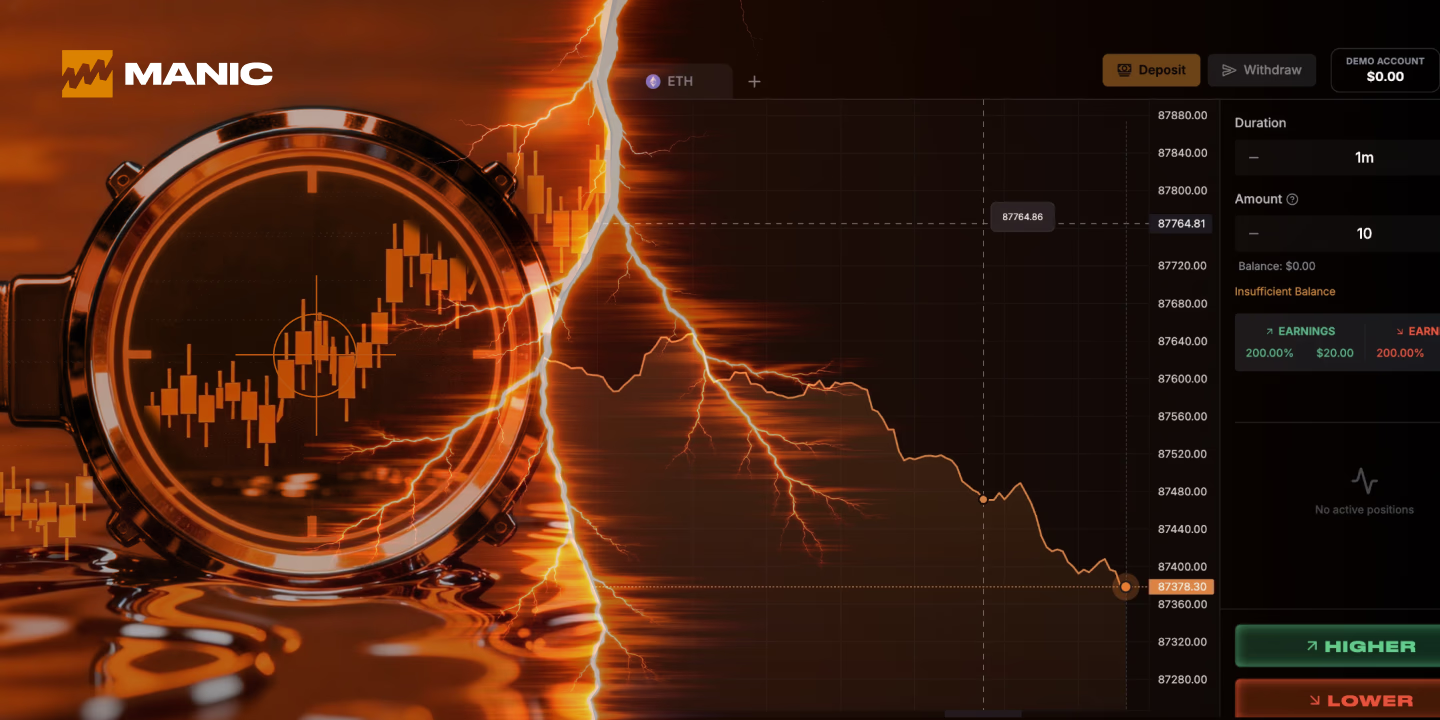
Manic.Trade is built on a different premise: crypto price direction with sub-second execution.
Platform features:
- 400ms Solana settlement — Position opens and closes in the same session, capital recycled immediately after exit (30× faster than Ethereum-based platforms)
- Price-based contracts — You trade SOL/USD going up or down in the next 30 seconds, not whether a geopolitical event resolves YES by Friday
- No KYC, no lockup — Connect wallet, trade in 30 seconds. No 1-3 day verification, no capital frozen in oracle resolution queues
- Multiplier system (3×–100×) — Dynamic risk/reward dial replaces fixed binary $0/$1 event contract payouts
The difference: Polymarket and Kalshi settle when the event resolves. Manic.Trade settles in 400ms. For momentum scalpers, that's not a feature comparison — it's a fundamental category difference.
Your pattern recognition edge works here. Your event outcome opinions don't. Trade crypto price direction →
FAQ
Q: Is Polymarket legal in the US?
Polymarket is not accessible to US users through standard means — the platform geoblocks US IP addresses following CFTC regulatory pressure in 2022 (Polymarket settled with the CFTC for $1.4M and agreed to block US users). US traders seeking regulated prediction market access should use Kalshi, which holds CFTC approval. Using VPNs to access Polymarket from the US creates regulatory and account-security risk that most serious traders avoid.
Q: Can you actually make money on Polymarket?
Yes — traders with genuine information advantage on event outcomes (political analysts, policy researchers, geopolitical experts) generate consistent edge on Polymarket. The platform uses real-money markets with meaningful liquidity on major events. The profitability condition is the same as any market: you need an information or analytical edge that other market participants don't have. For crypto technical traders, that edge (chart patterns, momentum signals) doesn't transfer to event outcome prediction — these require fundamentally different information sets.
Q: Why did Kalshi become popular for crypto traders specifically?
Kalshi launched contracts tied to crypto regulatory outcomes — things like "Will a spot Bitcoin ETF be approved?" and "Will Congress pass a crypto bill?" — which attracted crypto-native traders who confused "crypto-related event" with "crypto price trading." These contracts are macro regulatory bets, not price direction instruments. A trader who correctly bet on ETF approval in January 2024 made money on a Kalshi-style contract — but a different trader who traded BTC price momentum during the approval day made money on a price chart. Both can be valid; they require entirely different analysis frameworks.
Q: How does Polymarket's oracle system actually work?
Polymarket uses UMA's Optimistic Oracle for event resolution. When a market closes, a proposed resolution is submitted. If unchallenged for 48 hours, it resolves as proposed. If challenged, UMA token holders vote to determine the correct outcome. This system works well for unambiguous events (election winner, price threshold) but creates significant delays for contested or ambiguous events. The 2024 Iran attack contracts saw multi-day disputes over whether Israel's response met the specific criteria for "military retaliation." During this period, all capital remained locked.
Q: What's the minimum deposit to start on Polymarket vs Kalshi?
Polymarket requires only a Polygon wallet — you can start with any USDC amount, technically as low as $1. Kalshi requires account verification plus a minimum deposit (typically $10-25 depending on account tier). For context: neither platform has a meaningful practical minimum for serious position sizing. The relevant minimum for edge is position size relative to your average contract liquidity — very small trades on thin markets face worse pricing than well-sized trades on high-liquidity events.
Q: Can prediction markets be used as a hedge for crypto portfolios?
Yes, and this is one of the more legitimate use cases. If you hold significant BTC and are worried about a specific regulatory outcome (e.g., a US crypto ban vote), Polymarket or Kalshi contracts on that event can function as portfolio insurance. When your BTC loses value because the regulation passes, your YES position on that regulation gains value. This is a genuine hedging application — but it requires identifying a specific event that would cause your loss, not just general market volatility. For general downside protection, options or structured products are typically more capital-efficient.
Q: How does Manic.Trade differ from both Polymarket and Kalshi?
Manic.Trade operates in a completely different product category. Polymarket and Kalshi are event prediction markets — you bet on whether something happens by a specific date. Manic.Trade is a price direction platform — you trade whether SOL/USD goes up or down in the next 30 seconds to 5 minutes. Settlement on Manic.Trade happens in 400ms via Solana blockchain, using Pyth Network's decentralized oracle for real-time price feeds. There's no event resolution waiting period, no oracle dispute window, and no capital lockup. The core insight is that momentum trading edge — reading price structure, timing entries during pattern formation — only applies to price direction instruments, not event outcome contracts.
Q: Which is safer: Polymarket or Kalshi?
"Safety" depends on what you're protecting against. Kalshi is safer from a regulatory and custody perspective — CFTC oversight means stricter operational standards, and your USD is held in FDIC-insured accounts. Polymarket is safer from a geographic access perspective (no KYC means no identity exposure), but carries counterparty risk from operating without regulatory oversight. Smart contract risk exists on Polymarket (though the contracts have been audited); Kalshi uses traditional financial infrastructure. For US traders: Kalshi wins on regulatory safety. For global traders who prioritize privacy and access: Polymarket is the more accessible option.
Q: What happened to Augur and other early prediction markets?
Augur was the original decentralized prediction market on Ethereum, launched in 2018. It pioneered the on-chain event market model but suffered from several structural problems: Ethereum's gas fees made small trades uneconomical, the REP token governance system created perverse incentives for reporters, and the interface was too complex for mainstream adoption. Volume never recovered after 2019. Polymarket effectively replaced Augur's use case by moving to Polygon (lower fees), simplifying the UX, and using UMA's oracle instead of REP-based resolution. The lesson from Augur's failure is that technical infrastructure matters as much as the market concept — a point that applies equally to crypto price trading platforms.
Related Reading
Explore the Prediction Trading Silo:
- Polymarket Alternatives in 2026 — Why most "alternatives" are still event markets, and what price traders actually need
- Apps Like Kalshi in 2026 — The full landscape of prediction-adjacent platforms broken down by actual use case
- Trading Tools & Resources Hub — Platform evaluation tools and execution quality benchmarks
- The Speed Advantage — Why settlement speed is the core variable separating event markets from price markets
- Execution Trends Speed Trading — Where crypto execution infrastructure is heading in 2026
Cross-Pillar Connections:
- Momentum Trading Guide — The pattern recognition edge that only applies to price direction platforms
- Slippage Control — Why oracle-based settlement creates a form of structural slippage event market traders ignore
- Low Latency Trading — The execution architecture that makes sub-second settlement possible
- Cognitive Load — Why platform complexity (event research vs price reading) affects decision quality
- Trading Psychology — Mental frameworks that transfer from event betting psychology to price scalping