If you are searching for apps like Kalshi, the first step is figuring out what “like Kalshi” actually means for you. Some users want another platform for event contracts on elections, policy, or macro outcomes. Others want a platform that captures the same feeling of directional speculation, but on crypto price movement instead.
Those two needs lead to very different alternatives. A platform can feel similar at the surface level while solving a completely different problem underneath.
This guide breaks the options into clear categories so you can choose the right alternative based on what you were really trading.
What are the best apps like Kalshi in 2026?The best apps like Kalshi depend on your goal. If you want regulated event markets, Kalshi alternatives include other prediction and forecasting platforms like Polymarket, Manifold, and Augur. If you actually want to trade short-term crypto price direction, the closest functional alternative is a different category entirely, such as Manic.Trade.
Best by use case:
- For event markets: Polymarket
- For forecasting practice: Manifold
- For on-chain prediction markets: Augur
- For crypto price direction trading: Manic.Trade
Quick Takeaways
The Problem: Most Kalshi alternatives lists recommend the same 5-7 platforms regardless of what you were actually trading — sending event bettors to crypto platforms and momentum traders to prediction markets.
The Framework:
- ✅ Event traders (elections, Fed decisions, sports) → Polymarket, Manifold, PredictIt
- ✅ Crypto price direction traders (SOL/BTC/ETH movement) → On-chain momentum platforms built for sub-minute execution
- ✅ The key question: Was your Kalshi trade resolved by an event outcome or by a price level?
- ✅ If price level: Kalshi's architecture was already working against you — minimum expiry hours, USD settlement, thin crypto liquidity
Read time: 7 minutes | Decision: Know your use case in 60 seconds with the self-test below
Step 1: Which Type of Kalshi User Were You?
Answer these three questions. Be honest.
Q1: What did most of your Kalshi positions resolve on?
  A) An event outcome (election result, Fed rate decision, GDP number, sports score)
  B) A crypto price level (Will BTC be above $X by end of day?)

Q2: How long did you typically hold positions?
  A) Hours to weeks
  B) You wanted minutes or seconds but Kalshi's minimum expiry forced you to hold longer

Q3: What frustrated you most about Kalshi?
  A) Limited market selection, lower liquidity vs Polymarket
  B) Can't trade crypto price direction fast enough, KYC friction, USD-only settlement
If you answered mostly A: You're an event trader. Skip to Section 2.
If you answered mostly B: You're a crypto momentum trader using the wrong tool. Skip to Section 3 — that's where the actual answer is.
If it's mixed: Read both sections. You may need two separate platforms.
Section 2: If You Traded Events — Your Actual Kalshi Alternatives
This section is intentionally short. Event contract trading is a well-mapped space and the alternatives are straightforward.
Polymarket is the largest decentralized prediction market by volume. It runs on Polygon, uses USDC, requires no KYC for most users, and has deeper liquidity than Kalshi on major political and geopolitical markets. For non-US users especially, it's the default Kalshi alternative.
PredictIt is a regulated US platform focused on political markets — elections, legislation, policy outcomes. Smaller than Kalshi, more niche, but established.
Manifold Markets uses play money. No real financial exposure, but useful for forecasting practice and community prediction games without regulatory friction.
Metaculus is a forecasting platform, not a trading platform — no real money, but strong community calibration on scientific and geopolitical questions.
| Platform | Real Money | KYC | Best For | Regulation |
|---|---|---|---|---|
| Polymarket | ✅ USDC | No | Elections, geopolitics, crypto events | Unregulated (offshore) |
| PredictIt | ✅ USD | Yes | US political markets | CFTC no-action letter |
| Manifold | ❌ Play money | No | Practice, community forecasting | None |
| Metaculus | ❌ Play money | No | Scientific/long-horizon forecasting | None |
The honest summary: If you want regulated US event contracts with real money, Kalshi was already your best option and no direct alternative exists at the same regulatory level. Polymarket is the closest substitute for liquidity and market breadth, with the trade-off of offshore regulatory status.
If you're unclear on the distinction between event market vs price direction platform, our Polymarket vs Kalshi analysis walks through the oracle settlement mechanics, capital lockup timelines, and the specific trader profile each platform actually serves.
Note: Kalshi's US legal status shifted materially in February 2026 — Nevada courts cleared enforcement of a sports contract block, with 23 additional state lawsuits active. For traders evaluating platform stability alongside category fit, the [full regulation breakdown] is the most current reference.
Section 3: If You Traded Crypto Price Direction — Kalshi Was Never Built for You
This is where most alternatives guides go silent. They recommend Polymarket as a crypto alternative, which misses the point entirely.
Here's what Kalshi's crypto contracts actually look like:
- Minimum expiry: several hours (not minutes, not seconds)
- Settlement: USD through traditional financial rails
- Price feed: centralized
- KYC: required
- Liquidity on crypto contracts: thin compared to BTC/ETH spot markets
If you were on Kalshi trying to trade "Will SOL be above $180 in the next 30 minutes," you were forcing a momentum use case onto an event market infrastructure. The platform's architecture was working against you the entire time.
The three structural problems with Kalshi for crypto price direction:
Problem 1: Expiry windows are measured in hours, not seconds. Momentum trading requires entry and exit within the same price impulse — typically 30 seconds to 5 minutes. Kalshi's minimum crypto contract expiry is hours. By the time your contract resolves, the momentum event you identified has long since passed, reversed, and passed again.
Problem 2: USD settlement adds friction that kills scalping economics. Every Kalshi position flows through USD banking rails. For a trader executing dozens of positions per session on crypto price direction, this isn't just slow — it creates a cost structure incompatible with scalping. You need on-chain settlement where positions open, resolve, and return capital to your wallet within the same minute.
Problem 3: Crypto liquidity on Kalshi is structurally thin. Kalshi's core markets are elections and macro events — that's where the liquidity concentrates. Crypto price contracts are secondary markets with limited depth. For event traders, this doesn't matter much. For momentum traders trying to size into a breakout, thin liquidity means slippage, wide spreads, and positions that move the market against you.
Still thinking in event-market timescales? Most traders don't lose because they picked the wrong strategy. They lose because they never understood what execution infrastructure actually costs them per trade. The Speed Advantage: Why Sub-Second Execution Defines Winners →
The 2026 Landscape: New Entrants Worth Knowing
The prediction market space expanded significantly in late 2025 and early 2026. If you're returning to the alternatives question, several things changed.
New regulated US entries:
Robinhood Predictions — powered by Kalshi's backend. Identical markets and liquidity to Kalshi, wrapped in Robinhood's familiar interface. Worth considering if you already use Robinhood for stocks or crypto and want event contracts without a separate account. Note: Robinhood adds its own fee layer on top of Kalshi's spread.
FanDuel Predicts — launched December 2025, US-focused sports and political markets. Broad state availability but thinner market depth than Kalshi.
DraftKings Predictions — launched December 2025 in 38 states, sports and political focus.
New decentralized entrants:
OPINION (BNB Chain, launched October 2025) — focused on global macro and economic signals. TVL hit $158M by January 2026. Positions as a "people's terminal" for macroeconomic prediction markets. For event traders outside the US, worth evaluating.
Hedgehog Markets (Solana) — on-chain event prediction market. For users who want Solana settlement but are trading events (not price direction), this is a Solana-native option.
What Kalshi itself launched: 15-minute binary contracts on BTC, ETH, and SOL in January 2026 — the closest Kalshi has come to momentum trading. A 15-minute window is still structurally incompatible with 30–90 second momentum impulses, but it confirms that Kalshi recognizes the demand exists.
| Platform | Type | For Event Traders | For Momentum Traders |
|---|---|---|---|
| Robinhood Predictions | Kalshi frontend | ✅ Convenient | ❌ |
| FanDuel Predicts | CFTC-regulated | ✅ US-focused | ❌ |
| DraftKings Predictions | CFTC-regulated | ✅ US sports | ❌ |
| OPINION | On-chain (BNB) | ✅ Global macro | ❌ |
| Hedgehog Markets | On-chain (Solana) | ✅ Event-style | ❌ |
| Manic.Trade | On-chain (Solana) | ❌ | ✅ Built for this |
The pattern across every new entrant: all of them are event platforms. None solve the momentum infrastructure problem. The category gap that existed before 2026 still exists in 2026.
What Crypto Momentum Traders Actually Need
The requirements for crypto price direction trading at momentum timescales are specific:
Settlement speed under 1 second. Not "fast." Not "near-instant." Sub-second, verifiable, on-chain. At 400ms Solana block time, you can enter on pattern formation, hold through confirmation, and exit — all within a 4-second price impulse. At Kalshi's multi-hour expiry, that trade doesn't exist.
No KYC, no deposit delay. A momentum trader's edge is time-sensitive. A 24-48 hour KYC verification process doesn't just create friction — it means you miss the market condition that made you want to trade in the first place. Non-custodial wallet connection (30 seconds) is the only architecture compatible with momentum trading.
Zero or near-zero transaction fees. Kalshi builds spread into its contracts. Traditional platforms hide fees in price feeds. At Solana's $0.00025 per transaction, fees are effectively zero — which matters enormously when you're executing 20-50 positions per session. At $5-50 Ethereum gas fees per trade, momentum scalping isn't a strategy. It's a guaranteed money-losing exercise.
Decentralized price feed. This is the point most alternatives guides never reach. Kalshi uses a centralized price reference for its crypto contracts. Platforms built on Pyth Network aggregate pricing from 90+ institutional contributors — mathematically verifiable, not controlled by the platform. For a trader whose edge depends on entering at a precise price level, the integrity of that price reference isn't abstract. It's the entire game.
On-chain, non-custodial settlement. Your capital sits in your wallet. It doesn't sit in Kalshi's account, subject to withdrawal processing times, platform risk, or account restrictions. Every position opens from your wallet and resolves back to your wallet. No deposit. No withdrawal request. No waiting.
For traders who understand momentum trading at the micro-trend level, these aren't premium features. They're the minimum viable infrastructure for the strategy to function.
The Full Comparison: Kalshi vs Polymarket vs Manic.Trade
| Kalshi | Polymarket | Manic.Trade | |
|---|---|---|---|
| Built for | US event bettors | Global event traders | Crypto momentum scalpers |
| Crypto trading | Limited (event-style, hours+) | Limited (event-style, days+) | Continuous (30s–5min) |
| Settlement speed | Hours–days (USD) | Hours–days (USDC/Polygon) | 400ms (Solana) |
| KYC | Required | No (most users) | No |
| Custody | Platform holds funds | Platform holds funds | Non-custodial wallet |
| Price feed | Centralized | Centralized | Pyth Network (decentralized) |
| Fees | Spread-based | Spread-based | ~$0.00025/tx |
| Regulation | CFTC ✅ | Unregulated | Decentralized |
| Best use case | Elections, Fed, macro events | Elections, geopolitics | SOL/BTC/ETH price direction |
| Verdict for event traders | ✅ Best in class | ✅ Strong alternative | ❌ Wrong tool |
| Verdict for momentum traders | ❌ Wrong architecture | ❌ Wrong architecture | ✅ Built for this |
The table makes the point clearly: no single platform is the best Kalshi alternative for everyone. The question is which column matches your actual trading behavior.
Why Most "Apps Like Kalshi" Lists Miss This
The confusion exists because Kalshi's marketing positioned it as a broad financial trading platform — not just an event market. When you add crypto contracts to an event market platform, you attract momentum traders who don't realize they're using the wrong tool.
The result: momentum traders under-perform on Kalshi not because they lack skill, but because their strategy requires infrastructure Kalshi doesn't have. When they search for alternatives, they find lists that recommend more event market platforms — and the cycle repeats.
The pattern is identical to a different failure mode in traditional trading: using a platform built for institutional long-term investors to execute high-frequency scalp trades. The instruments exist. The execution architecture is wrong. The losses aren't random — they're structural.
Understanding how cognitive load affects trading decisions matters here too. Operating on a platform with the wrong expiry structure doesn't just limit your strategy — it forces you into a constant state of mismatched timing that degrades every decision you make.
Making the Decision: A 60-Second Framework
Answer these two questions:
| Q1: Do your trades resolve on an event outcome? | Q2: How fast? | Go here |
|---|---|---|
| Yes (election, score, data release) — US resident | Any | Kalshi · Robinhood Predictions · FanDuel Predicts |
| Yes (election, score, data release) — non-US | Any | Polymarket · OPINION |
| No (crypto price level) | Hours to days | Polymarket — event-style crypto contracts |
| No (crypto price level) | Seconds to minutes, on-chain matters | Manic.Trade — 30s min, 400ms, no KYC, Pyth |
| No (crypto price level) | Seconds to minutes, don't care about custody | Offshore binary — Quotex, Pocket Option (accept price feed risk) |
FAQ
What is the best app like Kalshi for crypto trading? For crypto event contracts (Will BTC be above $X by end of week?), Polymarket is the strongest alternative — deeper liquidity, no KYC, USDC settlement. For crypto price direction trading at momentum timescales (30 seconds to 5 minutes), you need a different category entirely: on-chain Solana platforms with sub-second settlement, decentralized price feeds, and no-KYC wallet connection. Kalshi and Polymarket are both built for event resolution, not momentum execution.
Are there other apps like Kalshi that are legal in the US? Kalshi is the only CFTC-regulated prediction market currently operating in the US with full legal standing for real-money trading. PredictIt operates under a CFTC no-action letter with restrictions (max $850 per contract, limited market selection). Polymarket technically restricts US users. For US traders who want legal event contract trading, Kalshi remains the only fully-compliant option — its alternatives involve regulatory trade-offs.
Who is Kalshi's biggest competitor? For event contract liquidity and market breadth, Polymarket is Kalshi's most direct competitor — larger trading volume on major political markets, no KYC friction, global access. For US regulatory standing, no direct competitor exists. For crypto-specific trading, the competitive set shifts entirely to on-chain Solana platforms, where Kalshi doesn't meaningfully compete due to architectural differences in settlement speed and contract structure.
What's better, Kalshi vs Polymarket? Depends entirely on your use case and location. Kalshi is better if you're a US resident who prioritizes regulatory protection and wants CFTC oversight. Polymarket is better if you're outside the US, want no KYC friction, or need deeper liquidity on major global events. Neither is "better" in absolute terms — they serve overlapping but distinct user bases. For crypto momentum trading, neither is the right answer.
Is Kalshi a gambling app? Kalshi is a CFTC-regulated exchange, legally classified as a derivatives market, not gambling. This distinction matters practically: Kalshi operates under federal financial regulation, offers investor protections, and reports to the CFTC. Traditional gambling platforms operate under state gaming licenses with different legal frameworks. The distinction is regulatory, not philosophical — the binary YES/NO structure looks similar, but the legal and structural treatment is fundamentally different.
What are the risks of Kalshi alternatives? The risk profile varies sharply by platform type. Polymarket carries offshore regulatory risk and smart contract risk (Polygon). Offshore binary platforms (Quotex, Pocket Option) carry centralized price feed risk and withdrawal restriction risk — documented cases of manipulation exist. On-chain non-custodial platforms carry smart contract risk but eliminate custody risk entirely since funds never leave your wallet. The safest regulatory environment remains Kalshi itself for US event trading. The safest custody structure is non-custodial on-chain settlement.
Can I trade crypto on Kalshi alternatives without KYC? Yes. Polymarket requires no KYC for most users. On-chain Solana platforms with non-custodial wallet connection require no KYC by design — there is no account to verify because you're connecting a self-custody wallet directly. The no-KYC options for crypto trading are primarily in the decentralized on-chain category, where the platform never holds your funds and therefore has no regulatory obligation to verify your identity.
Does Kalshi's 15-minute crypto contract make it a better alternative for momentum traders? No. Kalshi launched 15-minute binary contracts on BTC, ETH, and SOL in January 2026. For event traders, this extends Kalshi's product range. For momentum traders, a 15-minute minimum window is structurally incompatible with the 30–90 second impulses that define scalping. A correct 1-minute momentum read — price hits target in 45 seconds — still loses on a Kalshi contract because the expiry runs 14 more minutes while momentum reverses. The infrastructure gap is architectural, not incremental.
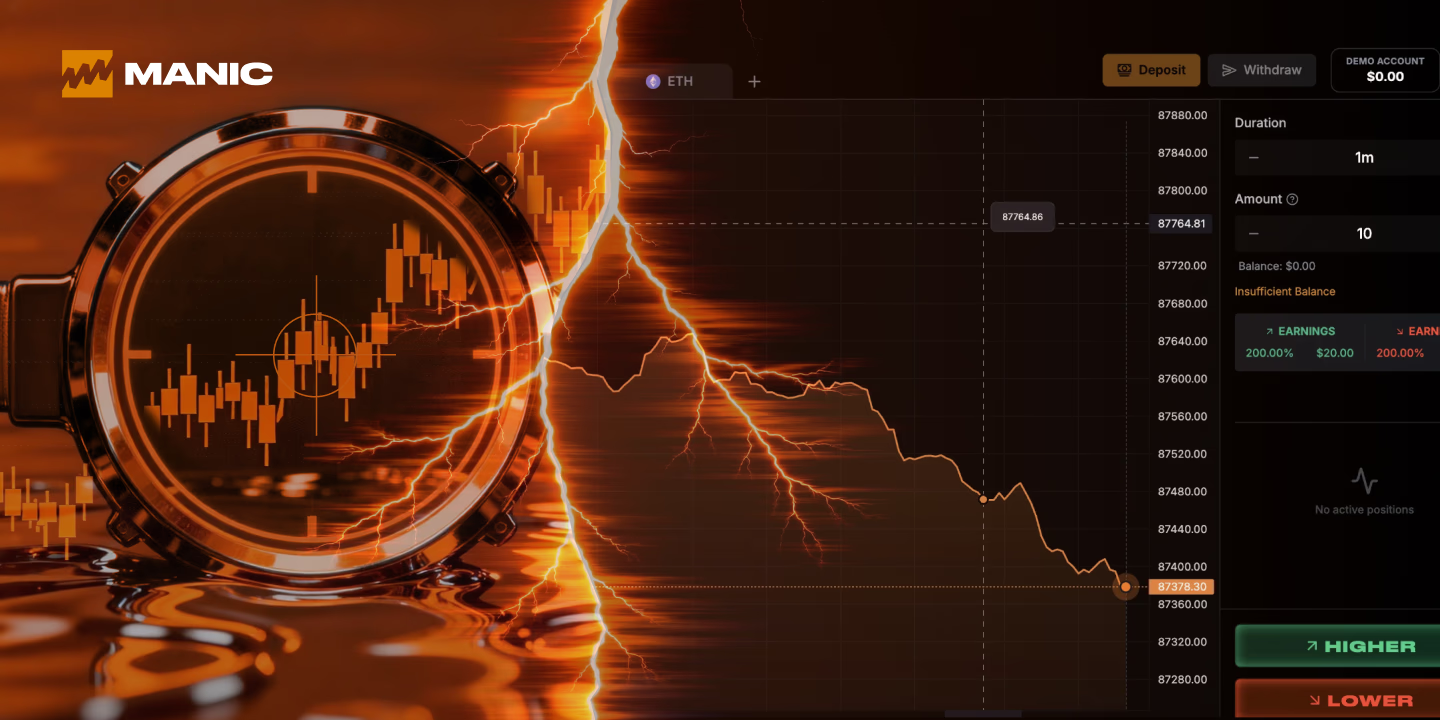
What is the actual product mechanic on Manic.Trade vs Kalshi? On Kalshi, you buy a YES/NO contract on an event outcome (e.g., "Will SOL be above $X at end of day?"). On Manic.Trade, you set a direction (HIGHER or LOWER), a duration (30 seconds to 5 minutes), a position size, and a payout multiplier. The platform places a Green Target Line above or Red Target Line below the current price. If price breaks through your target line before the timer expires, you win principal × multiplier — settled on Solana in 400ms. The binary direction structure is similar; the subject matter (event outcome vs price target), duration flexibility, and settlement infrastructure are fundamentally different.
Related Reading
Same Silo (Prediction Trading):
- Polymarket Alternatives in 2026: The Guide for Crypto Price Traders, Not Event Bettors — The pillar hub for this silo
- Kalshi Alternatives: If You Trade Crypto Price Direction, You Were Never Kalshi's Target User — Deeper dive on the infrastructure gap
- Momentum Trading Guide: How to Master Crypto Micro-Trends in 30 Seconds — Start here if momentum is new to you
- The Speed Advantage: Why Sub-Second Execution Defines Winners — Why 400ms is the infrastructure floor
- Trading Tools & Resources Hub — Full resource library
Cross-Pillar:
- From Paralysis to Pattern Recognition: How Cognitive Load Determines Trading Success — Why platform friction degrades every decision
- Slippage Control: The Architecture-First Approach to Crypto Execution — The hidden cost inside every alternative platform
- Low Latency Trading Crypto: Why 99% of Solutions Fix the Wrong Problem — The latency problem no event platform solves
- Panic Selling Crypto: Why Your Amygdala Fires Before Your Logic Can Respond — Platform misfit creates cognitive overload
- Execution Trends in Speed Trading: What the Next 18 Months Look Like — Where on-chain infrastructure is heading
The market doesn't care which app you're comparing. It cares whether your execution infrastructure matches your strategy. If your strategy is event contracts, Kalshi and Polymarket are legitimate answers. If your strategy is crypto price direction at momentum timescales, you've been looking in the wrong category.
The right alternative isn't the one with the best review score. It's the one built for what you're actually trying to do.
Start trading on Manic.Trade — no KYC, no deposit delays, 400ms Solana execution.