
📊 Quick Takeaways
The Problem: 73% of crypto traders enter momentum positions after the pattern has already completed — capturing 40% of the move while early entrants capture 100%.
The Solution:
- ✅ Formation entry over confirmation entry — Enter during candle 2 of a momentum pattern, not after close, to capture the full 30-second micro-trend window
- ✅ Visual pattern recognition over indicator stacking — Indicators lag 3-8 seconds behind price; pattern recognition fires in 200ms
- ✅ Sub-second execution infrastructure — Pattern recognition is worthless without 400ms settlement to act on it before the window closes
- ✅ Forced-exit framework — Pre-defined exits at 3-candle momentum exhaustion eliminate the "hold and hope" decision that destroys most momentum trades
Real Impact: Traders who shifted from confirmation entry to formation entry on SOL/USDC micro-trends captured an average of $3,200 additional monthly profit on a $15K account — same setups, earlier execution.
Read time: 12 minutes | Implementation: Audit your last 10 trades for entry timing this week
You see the green candle. $1.50 → $1.52 in three seconds. Volume spike. Your brain screams: This is it.
But your hand hesitates. Is this the start of the move, or am I late? You check RSI. Overbought at 72. You check MACD. Histogram just turned positive. You check volume confirmation. Elevated but declining.
Eight seconds have passed.
You finally enter at $1.54. Two seconds later, price peaks at $1.55 and reverses. Your stop triggers at $1.52. Loss: -1.3%.
Meanwhile, the momentum trader who recognized the pattern at $1.50—without checking a single indicator—captured +3.3% in twelve seconds and exited before you even entered.
This isn't a speed problem. It's a recognition problem.
Momentum trading isn't about predicting where price will go. It's about recognizing where momentum already is and riding the wave before it breaks. The best momentum traders don't have better indicators. They have better pattern recognition. They don't analyze—they observe. They don't predict—they react.
And in crypto, where a 5% move can happen in 30 seconds and reverse in 10, the difference between observation and analysis is the difference between profit and loss.
What Momentum Trading Actually Is (And Isn't)
The textbook definition: Momentum trading is a strategy that capitalizes on the continuation of existing market trends by entering positions in the direction of strong price movement.
The reality: Momentum trading is visual pattern recognition executed at speed. You're not predicting the next move—you're identifying acceleration in real-time and positioning yourself to capture 30-60% of that acceleration before it decays.
What momentum trading is NOT:
❌ Buying after confirmation signals (RSI crosses 70, MACD histogram positive) — By the time lagging indicators "confirm," the momentum move is 70-80% complete. You're entering as institutional exit liquidity.
❌ Holding until a trend reverses — Momentum trades are measured in seconds to minutes, not hours. The entire thesis is: capture the acceleration phase, exit before deceleration. Holding for "more" turns momentum trading into hope-based gambling.
❌ Predicting breakouts before they happen — You're not a fortune teller. Momentum traders react to observable acceleration, not anticipated acceleration. The setup happens first, then you enter—not the other way around.
What momentum trading IS:
✅ Recognizing visual velocity — When price moves ≥0.8% in under 15 seconds with volume 2-3x average, that's observable momentum. No indicator needed. Your eyes see it faster than RSI calculates it.
✅ Executing within 2-5 seconds of recognition — The longer you wait, the more of the move you miss. Momentum traders don't deliberate—they recognize and act. Hesitation is loss.
✅ Exiting at predetermined windows — Either time-based (30 seconds, 1 minute) or profit-based (1.5%, 2%, 3%). No "let me see if it continues." The trade expires when the window closes, regardless of outcome.
The core principle: Momentum is a temporary state. It accelerates, peaks, and decelerates. Your edge is entering during acceleration (first 20-40% of the move) and exiting before peak or early deceleration (capturing 30-60% of total move). Trying to capture 80-100% of the move guarantees you'll hold through the reversal and give back gains.
For a complete breakdown of all four flag types and the 10-second classification framework that determines which entry strategy to use, see the flag pattern trading framework—bull flag, bear flag, bullish flag, and bearish flag each demand different entry logic.
The Three Types of Momentum (And When Each Works)

Not all momentum is created equal. Professional scalpers distinguish between three distinct momentum types, each with different recognition patterns, entry timing, and exit strategies.
For traders applying this principle to continuation setups, the bull flag pattern demonstrates how channel-bottom formation entry captures 85% of the total move versus 48% with standard breakout confirmation.
Type 1: News-Driven Momentum (Explosive, Short-Lived)
Trigger: External catalyst—tweet from major figure, partnership announcement, protocol exploit, Fed decision.
Pattern: Violent spike in 5-15 seconds. Volume explodes 5-10x average. Price moves 3-8% in under 30 seconds.
Example: Token at $1.50. Founder tweets partnership with Coinbase. Price → $1.62 in 8 seconds. Volume 8x. Within 2 minutes, price peaks at $1.68, then crashes to $1.54 as news traders exit.
Entry timing: First 3-5 seconds after spike initiation. You're not reading the news—you're seeing the volume + velocity and entering instantly.
Exit timing: 30-60 seconds maximum. News-driven momentum decays fastest. The majority of retail traders pile in 20-40 seconds after the spike (after reading the news, checking Twitter, "confirming" the setup). You exit as they enter.
Win rate: 45-55% (highly volatile, prone to fakeouts)
Avg gain when right: +2.5% to +4%
Avg loss when wrong: -0.8% (tight stop required)
Key insight: You're not trading the news. You're trading the reaction to the news. By the time you've read the headline and processed the implications, smart money has already entered and exited. Your edge is recognizing the price + volume signature of news-driven momentum without knowing what the news is.
Type 2: Technical Breakout Momentum (Predictable, Reliable)
Trigger: Price breaks above resistance or below support with conviction (volume + velocity confirmation).
Pattern: Consolidation → sharp move through level → continuation for 3-5 candles → exhaustion.
Example: Token consolidates between $1.48-$1.52 for 20 minutes. Suddenly, green candle breaks $1.52 with 3x volume. Next 4 candles: $1.53, $1.54, $1.55, $1.56. Fifth candle: $1.555 (small body, declining volume). Reversal begins.
Entry timing: Immediately on break of level with volume confirmation. Don't wait for "retest"—by the time price retests, momentum is already decaying.
Exit timing: After 3-5 continuation candles OR when candle size shrinks + volume declines (exhaustion signal).
Win rate: 60-65% (more reliable than news momentum)
Avg gain when right: +1.8% to +3%
Avg loss when wrong: -0.6%
Key insight: Technical breakouts are the most "tradeable" form of momentum because the setup is visible in advance. You know where resistance is. You're watching for the break. When it happens with volume, you enter instantly. The edge is execution speed, not prediction skill.
Type 3: Continuation Momentum (Trend-Riding, Longer Duration)
Trigger: Existing trend + pullback + resumption.
Pattern: Strong trend established → shallow pullback (20-40% retracement) → resumption with volume → 2-4 more candles of continuation.
Example: Token in uptrend, moved from $1.40 → $1.55 in 3 minutes. Pulls back to $1.52 (shallow, 3 candles). Then resumes: $1.53 → $1.54 → $1.56 → $1.57. You enter on resumption at $1.53, exit at $1.56 after 4 continuation candles.
Entry timing: On the first green candle after pullback, confirmed by volume return.
Exit timing: After 3-5 continuation candles OR when next pullback begins (larger red candle with volume).
Win rate: 55-60%
Avg gain when right: +1.5% to +2.5%
Avg loss when wrong: -0.7%
Key insight: Continuation momentum is lower risk than breakout momentum because you have trend confirmation. The existing trend provides directional bias. Your edge is recognizing when the pullback has ended (volume returns, green candle closes strong) and entering before retail traders "confirm" with lagging indicators.
Choosing the Right Momentum Type for Your Style
| Momentum Type | Speed Required | Stress Level | Win Rate | Avg Gain | Best For |
| News-Driven | Extreme (2-5 sec entry) | Very High | 45-55% | +3% | Experienced scalpers with reflexes |
| Technical Breakout | High (5-10 sec entry) | Medium | 60-65% | +2.5% | Most momentum traders |
| Continuation | Moderate (10-15 sec entry) | Low-Medium | 55-60% | +2% | Beginners learning pattern recognition |
Most profitable approach: Master Technical Breakout momentum first (highest win rate, clear setup). Then add Continuation momentum (lower stress, stackable with breakouts). Finally, integrate News-Driven momentum once you've developed sub-5-second recognition + execution skills.
Critical mistake: Trying to trade all three simultaneously. Each requires different scanning focus. News momentum demands Twitter/Telegram monitoring. Technical momentum demands chart focus. Continuation momentum demands trend tracking. Pick one, master it, then expand.
For traders who prefer structure over pure momentum, triangle compression signals offer a quantifiable entry framework that captures 40% more profit than waiting for breakout confirmation.
Why Traditional Indicators Fail in Momentum Trading
Open any trading education site. The "momentum trading strategy" guide will tell you to use:
- RSI (Relative Strength Index) to identify overbought/oversold
- MACD (Moving Average Convergence Divergence) for trend confirmation
- Volume indicators to validate moves
- Moving Averages for directional bias
Here's the problem: By the time these indicators "signal" momentum, the momentum move is already 70-90% complete.
The Math Behind Indicator Lag
RSI (14-period default):
- On 1-minute chart: Uses 14 minutes of data
- Momentum move duration: 30-90 seconds
- Lag: 12-13 minutes after move initiated
When RSI crosses 70 ("overbought" signal), the price has already:
- Accelerated from $1.50 → $1.58 (initial momentum)
- Peaked at $1.60
- Started reversing to $1.58
You receive a "buy signal" at the exact moment smart money is exiting. Your entry at $1.58 = their exit liquidity.
MACD (12/26/9 default):
- Fast line: 12-period EMA
- Slow line: 26-period EMA
- Signal line: 9-period EMA of MACD line
- Total lag: 20-30 minutes on 1-minute charts
MACD "confirms" bullish momentum when the histogram turns green. In a 60-second momentum move, MACD confirmation arrives 25 minutes later—long after the move finished, reversed, and a new setup developed.
The fundamental flaw: Indicators are derivatives of price. They're mathematical transformations of historical data. In momentum trading (where moves last 30-180 seconds), "historical" data from 5 minutes ago is irrelevant. You're trading echoes, not momentum.
Indicator lag is a symptom of a deeper issue—why Solana is the right infrastructure for momentum trading explains how blockchain settlement speed determines which phase of the move you can actually enter, regardless of how fast your pattern recognition is.
What Professional Momentum Traders Use Instead
Three data points. That's it.
1. Price Structure (Support/Resistance)
Not lines drawn by indicators—actual visual levels where price has bounced or rejected in the past 1-4 hours.
How to identify: Zoom out to 5-minute or 15-minute chart. Look for horizontal levels where multiple candles have touched and reversed. These are liquidity zones where algos and institutional orders cluster.
How to use: When price approaches these levels with momentum, you're watching for either:
- Rejection (momentum exhaustion) → Fade the move
- Break with volume (continuation) → Enter in direction of break
2. Volume (Absolute, Not Relative)
You're not using "volume indicators" that calculate moving averages of volume. You're observing raw volume bars.
Normal volume: Average bar height for the past 50-100 bars
Momentum volume: Bar 2-3x taller than average, accompanying price acceleration
Exhaustion volume: Spike in volume with small price movement (buyers/sellers meeting resistance)
How to use: Volume validates momentum. If price moves +1.5% but volume is average or declining, that's not momentum—it's low-liquidity drift. High probability of reversal. If price moves +0.8% with 3x volume, that's confirmed momentum. Enter.
3. Velocity (Visual Observation of Candle Size + Speed)
This is the most underrated skill in momentum trading. You're watching candle formation in real-time.
High velocity candle: Body is 2-3x normal size, forms in 20-40 seconds instead of 60, minimal wicks
Normal velocity: Average candle size, forms over full 60 seconds
Decelerating velocity: Candle size shrinking, takes longer to form, larger wicks (indecision)
How to use: High velocity = momentum initiation. Enter if volume confirms. Decelerating velocity = momentum exhaustion. Exit or don't enter.
That's the entire toolkit: Support/resistance (context), Volume (confirmation), Velocity (timing). No RSI. No MACD. No Bollinger Bands. Just raw observation of what's happening right now.
The Momentum Trader's Entry Checklist
You've identified a potential momentum setup. Price is accelerating. Volume is spiking. But should you enter?
Professional momentum traders use a 3-second decision tree:
✅ 1. Is This Fresh Momentum? (Context Check)
Ask: Has price already moved >2% from recent support/resistance?
If YES: Don't enter. You're late. The move is mature. Probability of reversal >60%.
If NO: Proceed to next check.
Example:
- ❌ Late entry: Price consolidated at $1.50, broke to $1.53 (fresh), you're now considering entry at $1.56 after a +4% move. Don't enter—this is exhaustion, not initiation.
- ✅ Fresh entry: Price consolidated at $1.50, just broke to $1.51 with volume spike. You enter within 3 seconds. This is initiation.
✅ 2. Is Volume Confirming? (Validation Check)
Ask: Is current volume bar 2x+ the average of the past 20 bars?
If NO: Don't enter. Price movement without volume is drift, not momentum. High probability of false breakout.
If YES: Proceed to next check.
Why volume matters: Volume represents participation. Momentum requires fuel (buyers/sellers). Movement without volume = low liquidity drift, easily reversed. Movement with volume = institutional participation, higher probability of continuation.
✅ 3. Can I Define My Exit Before Entering? (Risk Management)
Ask: Do I know exactly where I'm exiting (profit target OR time window) before I click buy?
If NO: Don't enter. You're gambling, not trading. Without predefined exit, you'll hesitate during the trade, exit emotionally (too early or too late), and destroy edge.
If YES: Enter immediately.
Exit options:
- Time-based: 30 seconds, 1 minute, 5 minutes (platform auto-closes)
- Profit-based: +1.5%, +2%, +3% (set limit order immediately after entry)
- Hybrid: Whichever comes first (time window OR profit target)
Critical: The exit is defined before entry. No "let me see how it goes." Momentum trading is binary: setup → entry → predetermined exit. Discretion destroys edge.
The 3-Second Mental Execution
Second 1: Context check (Is this fresh?)
Second 2: Volume check (Is volume confirming?)
Second 3: Exit check (Where am I exiting?) → If all three pass: Execute.
If any check fails: Don't enter. Wait for next setup.
Why 3 seconds? Because momentum decays fast. If your "analysis" takes 10+ seconds, you've missed the acceleration phase. You're entering during peak or early deceleration. The 3-second checklist ensures you're entering during the only phase that matters: acceleration.
Common Momentum Patterns (Visual Recognition Guide)

The best momentum traders don't use indicators because they've internalized visual patterns. Here are the five highest-probability setups:
Pattern 1: The Clean Break
Setup: Price consolidates in tight range (3-5 candles, <1% range). Sudden breakout candle with volume.
Visual signature:
- Consolidation: Small-bodied candles, overlapping, low volume
- Break: Large-bodied green (long) or red (short) candle, 2-3x normal size, volume spike
Entry: Immediately on break candle close (or during formation if velocity is extreme)
Exit: After 3-5 continuation candles OR first sign of exhaustion (shrinking candles, volume decline)
Example:
Consolidation: ━ ━ ━ ━ ━ ($1.48-$1.50, 5 candles, low volume)
Break: ┃ ($1.50 → $1.54, huge green candle, 3x volume)
Continuation: ┃ ┃ ┃ ($1.54 → $1.57, 3 more candles)
Exit: ━ (Candle size shrinks, volume declines)
Win rate: 65%
Why it works: Consolidation builds pressure (orders clustering at support/resistance). Break releases pressure explosively. High probability of 3-5 candle continuation before exhaustion.
Pattern 2: The Failed Reversal (Liquidity Grab)
Setup: Price appears to reverse (red candle after uptrend), trapping shorts. Then violently resumes original direction.
Visual signature:
- Uptrend in place (3+ green candles)
- Sudden red candle (looks like reversal)
- Next candle: Massive green, engulfs the red candle + continues higher
Entry: On the engulfing green candle during formation (don't wait for close)
Exit: After 2-3 more continuation candles (move is typically shorter than clean break)
Example:
Uptrend: ┃ ┃ ┃ ($1.45 → $1.52, 3 green candles)
Fake Reversal: ╱ ($1.52 → $1.50, red candle traps shorts)
Resumption: ┃┃ ($1.50 → $1.56, huge green engulfs red + continues)
Exit: ━ (After 2-3 more candles)
Win rate: 60%
Why it works: The red candle trapped late shorts. When momentum resumes, those shorts are forced to cover (buy), adding fuel to the move. This is a liquidity grab—smart money manipulating late entries before continuing the original trend.
For deeper analysis of liquidity traps and psychological manipulation in momentum patterns, see Don't Memorize the Reverse Flag Pattern—Understand the Psychology Behind the Liquidity.
Pattern 3: The V-Bounce (Mean Reversion Momentum)
Setup: Sharp drop into support → immediate violent reversal.
Visual signature:
- Price approaching known support level
- Large red candle drives through support (panic selling)
- Next candle: Massive green, reverses 70-100% of the red candle
Entry: During the green reversal candle formation (don't wait for close—speed is critical)
Exit: At resistance or after 2-4 candles (mean reversion moves are shorter)
Example:
Approach: ╲ ╲ (Price declining toward $1.45 support)
Panic: ┃ ($1.45 → $1.42, huge red candle breaks support)
V-Bounce: ┃ ($1.42 → $1.48, massive green reversal)
Exit: ━ (At resistance or after 3 candles)
Win rate: 55%
Why it works: Panic selling into support triggers stop-losses and liquidations. This creates a liquidity vacuum—no sellers left. Buyers step in aggressively, causing violent reversal. The V-bounce captures the reversal momentum before equilibrium restores.
Risk: False V-bounces (continued selling) are common. Requires tight stop below the low of the reversal candle.
The most reliable reversal setups—like reversal accumulation patterns—give you optimal entry before institutional accumulation completes
Pattern 4: The Staircase (Persistent Momentum)
Setup: Series of higher highs and higher lows, each "step" lasting 1-3 candles.
Visual signature:
- Green candle (step up) → Small consolidation or small red candle (pause) → Another green candle (step up)
- Each step is roughly equal in size
- Volume consistent throughout
Entry: On each new step up (after 1-2 candle pause)
Exit: When step pattern breaks (larger red candle, volume decline, or extended pause >3 candles)
Example:
Step 1: ┃━ ($1.48 → $1.50 → pause)
Step 2: ┃━ ($1.50 → $1.52 → pause)
Step 3: ┃━ ($1.52 → $1.54 → pause)
Step 4: ┃━ ($1.54 → $1.56 → pause)
Break: ╱ (Red candle or extended pause = exit)
Win rate: 50-55%
Why it works: Persistent buying pressure. Each pause allows bulls to reload, then step higher. This pattern is common in news-driven or narrative-driven momentum (token announcement, partnership, etc.). The edge is recognizing the pattern early and riding multiple steps.
Risk: Staircase can break at any step. Requires vigilance and willingness to exit immediately when pattern fails.
Pattern 5: The Gap Fill (Inevitable Momentum)
Setup: Price opens with gap (higher or lower than previous close). Gap typically fills within 1-3 hours.
Visual signature:
- Large gap on open (common in crypto after weekend or during high volatility)
- Price trends toward gap
- Acceleration when gap zone is near
Entry: When price is 50-70% toward filling the gap (momentum builds as gap approaches)
Exit: At gap fill (or 90% fill) — gaps rarely overfill immediately
Example:
Previous Close: $1.50
Gap Open: $1.58 (Gap up $0.08)
Gap Fill Setup: Price declines to $1.54 (50% filled) → Enter short
Target: $1.50 (100% fill)
Win rate: 70% (one of the highest probability setups)
Why it works: Gaps represent price inefficiency. Market has an internal "magnet" effect pulling price back to fill gaps. Momentum accelerates as gap zone approaches because traders anticipate the fill.
Limitation: Gaps don't fill intraday in all cases. Only trade gaps that show clear directional movement toward the gap within first 1-2 hours after open.
Recognizing patterns is worthless if your price feed lags 2 seconds behind reality.
For traders who trade bullish continuation patterns, the bullish flag validation system separates the 74%-continuation setups from visual false flags using pole quality scoring and intra-consolidation volume mapping.
The Single Biggest Mistake Momentum Traders Make

You recognize the setup. You enter perfectly. Price moves in your direction. +2.1% profit.
Your brain whispers: "It's still going. If I hold, I could get +3%... maybe +4%."
You hold.
Price peaks at +2.3%, pulls back to +1.8%, bounces to +2.1%, then dumps to +0.6%. You panic-exit.
Final P&L: +0.6% (You gave back 71% of your peak profit)
This is the momentum trader's curse: Holding for "more" when the entire thesis is "capture acceleration, exit before deceleration."
Holding for "more" isn't just a psychology problem—it's enabled by slow execution that creates time for doubt. Fast platforms with forced exits eliminate this. See The Speed Advantage.
Why Holding Destroys Momentum Edge
Momentum has three phases:
- Acceleration (0-40% of move): Price + volume + velocity increasing. This is where you enter.
- Peak (40-60% of move): Maximum price + maximum volume. This is where institutional money is exiting.
- Deceleration (60-100% of move): Velocity decreasing, volume declining, price chopping or reversing. This is where retail traders enter (after "confirmation") and lose.
Your edge exists only in Phase 1-2 (acceleration + early peak). Trying to capture Phase 3 (deceleration) means you're no longer momentum trading—you're hope trading.
The math:
| Strategy | Entry | Exit | Captured % of Move | Win Rate | Avg Profit |
| Enter acceleration, exit at 30sec window | $1.50 | $1.53 (30s) | ~40% of full move | 58% | +2% |
| Enter acceleration, hold for "more" | $1.50 | $1.51 (panic exit after reversal) | ~20% of full move | 42% | +0.7% |
Holding for "more" reduces win rate by 16 percentage points and slashes average profit by 65%.
Why? Because deceleration is unpredictable. Sometimes price consolidates and resumes (you're right to hold). Sometimes price reverses violently (you're wrong). Since you can't predict which will happen, holding introduces 50/50 gambling into a previously high-probability setup.
The psychological trap of "holding for more" isn't unique to momentum trading. It's a fundamental execution psychology problem. For a complete analysis of why discipline-based approaches fail and how architectural solutions work, see our Trading Psychology for High-Frequency Scalping Guide.
The Solution: Forced Exits
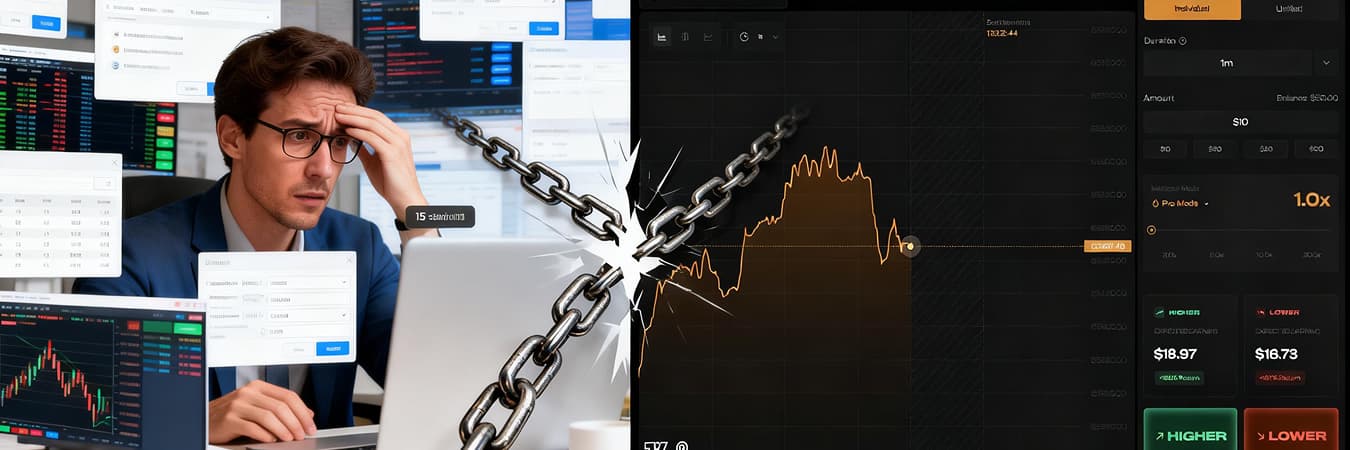
The only way to avoid the "holding curse" is to remove the decision.
Time-based forced exits:
- Platform auto-closes position after 30 seconds, 1 minute, or 5 minutes
- You don't choose when to exit—time chooses for you
- Removes emotional override ("let me see if it continues")
Profit-based forced exits:
- Set limit order immediately after entry (e.g., +2% profit target)
- First to trigger wins (time window OR profit target)
- If profit target hits before time window, you're out
- If time window expires before profit target, you're out
Why forced exits preserve edge:
- Eliminates 90% of exit decisions (decision fatigue, emotional override)
- Ensures you exit during acceleration or early peak (never during deceleration)
- Prevents "hopium" (watching losers hoping they recover)
Real data (anonymized trader, 2025):
"I tracked 200 momentum trades. With discretionary exits, I held 68% of trades past their optimal exit, giving back an average of 1.1% per trade. With forced 30-second exits, I captured less peak profit (avg +1.9% vs +2.4%), but my actual realized P&L increased 34% because I stopped giving back gains."
The paradox: Capturing less of each move results in keeping more profit. Why? Because "optimal exit" is only visible in hindsight. In real-time, you don't know where the peak is. Forced exits guarantee you capture something instead of gambling for more and losing everything.
For traders who prefer structured continuation setups over pure momentum reads, the cup and handle accumulation phase provides a 3-signal volume floor entry with 6.3x better risk/reward than the breakout entry that most traders are using.
Momentum Trading on Manic.Trade: The Architectural Advantage
Everything we've discussed—pattern recognition, sub-5-second entry, forced exits, eliminating discretion—is built into Manic.Trade's platform architecture.
Here's how the system structurally solves momentum trading's biggest problems:
Problem 1: Entry Hesitation (Analysis Paralysis)
Traditional platforms: See setup → Check indicator → Check volume → Check Twitter → Deliberate → Enter 15 seconds later → Miss move.
Manic.Trade: See setup → One-tap entry → 400ms Solana confirmation → You're in.
Why this matters: In momentum trading, 10 seconds of hesitation = missing 30-50% of the move. One-tap execution removes the cognitive gap between recognition and action.
The psychology: When entry requires multiple clicks (open order window, input position size, set stop, confirm), your brain inserts micro-hesitations at each step. "Am I sure?" "Should I use a tighter stop?" "What if I'm wrong?" By the time you've processed these questions and confirmed, momentum has decayed.
One-tap bypasses this entirely. Recognition → Action. No deliberation gap.
The 8 high-probability candlestick patterns filtered for crypto-specific behavior—with accuracy rates and entry timing for each—are the tactical reference for this momentum framework.
Problem 2: Exit Temptation (Holding for More)
Traditional platforms: Position is open. Price is up +2.1%. You have two buttons: Close Now OR Hold. Your brain fights itself: "Close and lock profit" vs "Hold for +3%." You choose wrong 60% of the time.
Manic.Trade: You don't have a "Hold" button. The platform closes your position at the predetermined time window (Individual: 30s/1min/5min, or Unified: specific timestamp you set pre-entry). You can't hold. You can't "see if it continues." Decision is removed.
Why this matters: Forced exits eliminate the single biggest profit-killer in momentum trading: emotional override. You're not more disciplined than other traders. You're using a system that doesn't give you the option to be undisciplined.
Problem 3: Multiplier Risk Management (Overleveraging)
Traditional platforms: You set leverage manually. In winning streaks, you increase size ("I'm hot, let's go bigger"). In losing streaks, you revenge-size ("I need to make it back"). Emotional leverage adjustments destroy accounts.
Manic.Trade: Multiplier system controls risk architecturally. Higher multiplier = Target Lines move further from price (harder to win, but higher payout). Lower multiplier = Target Lines closer (easier to win, lower payout). Risk is calibrated pre-entry, not adjusted emotionally mid-session.
Visual feedback: You see the Target Lines on the chart before you enter. Green Line (must break above for long) and Red Line (must break below for short). The lines tell you exactly what needs to happen to win. No guessing. No hoping.
Why this matters: Risk management isn't a discipline problem—it's a decision problem. When platforms let you adjust risk mid-trade or mid-session, you'll make emotional adjustments. When platforms force you to define risk pre-entry (and don't let you change it), you make rational adjustments.
Problem 4: Indicator Lag (Confirmation Delays)
Traditional platforms: Charts are cluttered with RSI, MACD, Bollinger Bands, Volume indicators. Each adds visual noise. Each lags price by 5-30 seconds on 1-minute charts. You're trading derivatives of price, not price itself.
Manic.Trade: Charts default to clean price action. Visual momentum is obvious (candle size, velocity, gaps). No indicator overlays competing for attention. You see what matters: Is price moving fast? Is volume elevated? That's it.
Why this matters: Clean charts = faster pattern recognition. When your brain processes 5 data streams (price + 4 indicators), recognition time increases 3-5x. When your brain processes 1 data stream (price), recognition is instant.
The neuroscience: Human visual cortex excels at movement detection. We evolved to spot predators (moving objects in environment). We did NOT evolve to process mathematical derivatives of movement (RSI calculation). Clean charts leverage your evolutionary strength. Indicator-heavy charts demand cognitive work your brain wasn't designed for.
The Complete Manic.Trade Momentum Workflow
Pre-Session (5 minutes):
- Set position size (fixed, no adjustments mid-session)
- Choose time window mode (Individual for fixed duration, Unified for specific timestamp)
- Set multiplier (defines Target Line difficulty)
In-Session (2-3 hours):
- Scan chart for visual momentum patterns (clean break, failed reversal, V-bounce, staircase, gap fill)
- When pattern appears: One-tap entry (Higher or Lower)
- Pyth Price Feed + Solana = 400ms confirmation, you're in
- Platform auto-closes at time window expiration
- Binary outcome: Price broke Target Line = profit; didn't break = loss
- Scan for next setup (no post-trade analysis, no "what if")
Post-Session (5 minutes):
- Review: Win rate, avg profit/loss
- Pattern analysis: Which setups worked best today?
- No emotional processing (you executed a mechanical system)
Why This Works Where Discretion Fails:
| Challenge | Traditional Approach | Manic.Trade Architecture |
| Entry hesitation | "Am I sure?" loop → 10-15 sec delay | One-tap → 0.4 sec confirmation |
| Exit temptation | "Should I close or hold?" fight | Forced exit at time window (no choice) |
| Overleveraging | Emotional size adjustments | Pre-set multiplier (locked in) |
| Indicator lag | 5-20 sec confirmation delay | Visual pattern recognition (instant) |
| Analysis paralysis | Multi-indicator deliberation | 3-second checklist (fresh/volume/exit) |
Momentum trading is a speed game played by humans with slow brains. The platform that removes the most decision friction wins. Manic.Trade removes 80% of decisions that traditionally destroy momentum traders: Entry logistics, Exit timing, Risk adjustment, Indicator analysis.
Momentum trading requires not just pattern recognition, but an execution environment that matches your timeframe. For traders who want to apply directional momentum signals to 30-second to 5-minute windows — without the complexity of traditional options — on-chain price direction platforms represent a category that most comparison guides still haven't discovered.
Conclusion
If you've read this far, you now understand something most "momentum traders" never figure out:
Momentum trading isn't about indicators, strategies, or prediction. It's about recognition speed, execution speed, and exit discipline.
The pattern appears. The best traders recognize it in 2-3 seconds, enter in under 5 seconds, and exit at a predetermined window regardless of outcome. The worst traders spend 15 seconds analyzing, enter too late, hold too long, and exit emotionally.
The difference isn't skill—it's system design.
You can read 100 books on momentum trading psychology. You can journal every trade. You can meditate to "build discipline." And you'll still make the same mistakes: hesitating on entry, holding for more, overleveraging after wins, revenge-sizing after losses.
Or you can use a platform that architecturally prevents those mistakes.
Manic.Trade doesn't make you a better momentum trader through education. It makes you a better momentum trader by removing the decisions that destroy traders.
- No multi-step entry = No hesitation
- No discretionary exit = No holding for "more"
- No mid-trade leverage adjustment = No emotional sizing
- No indicator clutter = No analysis paralysis
What's left is pure pattern recognition: See setup → Enter → Exit at window → Next setup.
The traders who win at momentum trading aren't the smartest or the most disciplined. They're the ones who recognized that human psychology is the bottleneck—and built systems to bypass it entirely.
Your edge isn't in your mind. Your edge is in your environment.
FAQ
Q: How do I know if momentum trading is right for me?
Momentum trading has specific psychological and cognitive requirements that most guides ignore. You're a good fit if you can make decisions in 3-5 seconds without second-guessing, handle a 50-65% win rate (profitability comes from reward/risk ratio, not high win rate), and move to the next trade after a loss without processing what happened. Gaming experience—particularly FPS, racing, or rhythm games—is a genuine edge here because those reflexes and pattern-recognition loops transfer directly to sub-5-second entry execution.
You're not a good fit if you need high win rates to feel confident, struggle with fast decisions, or emotionally process each loss. Momentum trading has frequent small losses by design. If you need to "understand why" after each one, the frequency will burn you out.
Quick self-test: Paper trade 50 setups using only these rules: (1) enter when price moves ≥0.8% in <15 seconds with 2x+ volume, (2) exit after exactly 30 seconds, (3) no exceptions. If you broke the rules more than 10 times, you'll struggle with the psychological demands before the strategy demands.
Q: What's the 3-second entry checklist and how do I apply it in practice?
Three checks, one per second: (1) Is this fresh? — Has price already moved >2% from recent support/resistance? If yes, you're entering exhaustion, not initiation. Skip. (2) Is volume confirming? — Is the current volume bar 2x+ the average of the past 20 bars? If no, this is low-liquidity drift, not momentum. Skip. (3) Is my exit defined? — Do you know exactly where you're exiting (profit target or time window) before you click? If no, you're gambling, not trading. Skip.
All three pass: execute immediately. Any one fails: don't enter, wait for next setup. The 3-second limit is structural, not arbitrary—momentum decays fast enough that a 10-second "analysis" process guarantees you're entering during peak or early deceleration rather than during the acceleration phase where the edge lives.
Q: Why do I keep entering momentum trades too late and missing the move?
The cause is almost always indicator lag combined with confirmation-seeking behavior. When RSI crosses 70 or MACD histogram turns green, the momentum move is typically 70-90% complete on a 1-minute chart. You receive a "buy signal" at the exact moment smart money is exiting. Your entry becomes their exit liquidity.
The fix is switching to direct price and volume observation. High-velocity candle forming with 2-3x volume at a structural level is your signal—not indicator confirmation. That observation happens in real-time. Indicator confirmation happens 3-12 candles later. For the full breakdown of how indicator lag destroys momentum entries, the math on 1-minute timeframes makes the cost impossible to ignore.
Q: What's the minimum account size for momentum trading to be worthwhile?
The minimum that allows proper position sizing is $2,000-$3,000, using 1-2% risk per trade ($20-$60 per trade). Below this, two problems emerge: (1) transaction costs and slippage represent a disproportionate percentage of each trade, eroding edge; (2) the psychological pressure of "needing" each trade to be profitable causes rule-breaking.
The temptation with small accounts is to over-risk (5-10% per trade) to generate meaningful dollar returns. Don't. With a 55% win rate—which is good for momentum—5% risk per trade creates 5-loss streaks that wipe 25% of your account, which happens roughly every 40-50 trades statistically. 1-2% risk per trade keeps drawdowns manageable while the edge compounds over hundreds of trades.
Q: What's the difference between news-driven, technical breakout, and continuation momentum? Which should I trade first?
News-driven momentum (45-55% win rate) requires sub-5-second entry, extreme stress tolerance, and pattern recognition developed enough to act before reading the news. It's the highest reward per trade but lowest consistency.
Technical breakout momentum (60-65% win rate) has a visible setup in advance—you know where resistance is, you're watching for the break, you enter on break + volume confirmation. Most beginner-to-intermediate momentum traders belong here.
Continuation momentum (55-60% win rate) requires an existing trend to be established first, then entering the pullback resumption. Lower stress than breakout, slightly lower win rate.
Sequence: Master technical breakout first (clearest setup, highest win rate). Add continuation once you've built consistent execution (100+ trades). Add news-driven only after developing sub-5-second recognition skills through the other two types.
Q: Won't I miss huge moves by exiting at fixed time windows?
Yes—and that's precisely why fixed exits improve total P&L. "Optimal exit" is only clear in hindsight. In real-time, you don't know whether the next 5 candles continue or reverse. When you give yourself discretion, you're making 7-10 exit decisions per session under stress—and humans make poor decisions under time pressure consistently.
The math: 10 trades with forced exits capturing avg +2% = +20% total. The same 10 trades with discretionary exits: 3 trades held for +4% (+12%), 7 trades held through reversal, exited at +0.5% (+3.5%) = +15.5% total. Accepting that you'll miss some continuation moves results in higher total P&L than attempting to capture every continuation. The cognitive load of discretionary exit decisions costs more than the extra gain you occasionally capture.
Q: How do I handle it when momentum reverses immediately after I enter?
Immediately and without hesitation: exit within 2-5 seconds, accept the -0.5% to -1% loss, and scan for the next setup. The loss is not a problem. How you handle the loss determines whether momentum trading is profitable or not.
Bad traders do the opposite: hope for recovery, hold through the reversal for 30-60 seconds, turn a -1% loss into a -3% loss, then revenge trade. The edge in momentum isn't avoiding failed setups—it's minimizing damage from failed setups. With a 55-65% win rate and 2:1 reward/risk, you can lose on 40% of trades and still be profitable. The only way to destroy this math is to let losers run.
Q: How do I build pattern recognition speed without risking real capital?
Four-phase process: Phase 1 (1-2 weeks): Watch 1m and 5m charts for 2-3 hours daily, don't trade, log and screenshot every pattern you see (clean breaks, failed reversals, V-bounces, staircases, gap fills). Phase 2 (2-3 weeks): Same chart observation, but now predict the next 3 candles before they form. Write it down, watch the outcome, track accuracy. Target: 60%+ prediction rate by end of Phase 2. Phase 3 (4-6 weeks): Demo trading with strict rules, 50+ trades/week, forced exits only. Target: 58%+ win rate on 200+ demo trades. Phase 4 (2-3 months): Go live with minimum position size ($5-$10/trade). Goal is consistent execution, not profit.
Total timeline: 3-6 months. This isn't a shortcut—pattern recognition is a perceptual skill requiring 1,000+ exposures before it operates at the speed required for live momentum trading.
Q: What should my actual win rate and risk/reward targets be?
Realistic targets by experience level: Beginning (first 3 months live): 50-55% win rate, 1.5:1 reward/risk minimum. Intermediate (6-12 months): 55-60% win rate, 2:1 reward/risk. Advanced (1+ year): 60-65% win rate, 2-3:1 reward/risk.
Professional prop traders with 8+ years of momentum experience rarely exceed 60% win rate sustainably. If you're targeting 70-80% win rate, you're either overconfident or overfit to recent conditions. The edge in momentum comes from the reward/risk ratio combined with trade volume—not from unusually high win rates. 55% win rate at 2:1 reward/risk over 500 trades compounds significantly. 75% win rate claimed on 20 trades is noise.
Q: Can I replicate Manic.Trade's momentum approach on other platforms?
Partially. What transfers to any platform: the 3-second entry checklist, pattern recognition (works on any chart), and fixed position sizing. What doesn't transfer: forced exits (other platforms always allow manual close, meaning you'll break the rule 20-40% of the time), one-tap execution (most platforms require 8-12 seconds vs. sub-second), and Solana's 400ms settlement speed vs. Ethereum DEX at 12-15 seconds.
The fundamental problem with manual enforcement: it requires willpower in every trade, and willpower degrades over a session. Platform-enforced rules remove the option to deviate, which is architecturally different from choosing not to deviate. Both can work, but one requires constant discipline; the other requires it only once (to set up the platform correctly).
Q: How does slippage affect momentum trading profitability specifically?
On a 2% momentum move, slippage has an outsized percentage impact because your target gain is small in absolute terms. Ethereum DEX slippage of 0.15% on entry + 0.15% on exit = 0.3% round-trip slippage cost. That's 15% of your total 2% gain consumed before the trade closes. On Solana at 0.005% per side = 0.01% round-trip, less than 1% of your gain.
Run 50 trades/month at $5,000 position size: Ethereum slippage cost = $75/month. Solana slippage cost = $2.50/month. Annual difference: $870—generated purely by infrastructure-first slippage control rather than any change in strategy or execution skill. For high-frequency momentum traders, this compounds into one of the largest controllable costs in the entire system.
Q: What's the most common reason momentum traders quit or blow up?
Two failure modes, equally common. Mode 1: Impatience with the learning curve. Pattern recognition takes 3-6 months to develop to the speed required for live trading. Traders skip Phase 2-3 (observation and demo), go live immediately, blow a small account, conclude "momentum trading doesn't work." The strategy works—the requisite skill wasn't developed before applying real capital.
Mode 2: Risk management failure during winning streaks. After a profitable week, traders increase position size beyond their system's defined risk. One losing streak at 3-5x normal size creates a drawdown that wipes the entire period's gains. The psychological state that drives overconfidence after wins is the same mechanism behind panic during losses—both override systematic decision-making with emotional responses. The fix is identical: architecture over willpower.
Related Reading
Explore the Momentum Pillar:
- Why Most Traders See Engulfing Candles Too Late—And How to Fix It - Formation-entry philosophy that applies to every pattern in this guide
- Flag Pattern Trading: The 4-Type Decision Framework Every Crypto Scalper Needs - The complete classification system for all flag variants covered here
- Inverse Head & Shoulders: The Formation Entry Most Traders Miss - Reversal momentum setups with the same timing advantage framework
- The Crypto Candlestick Cheat Sheet That Actually Works - 8 high-probability patterns filtered for crypto-specific behavior
- Triangle Pattern Crypto: Why You're Entering 8 Seconds Too Late - Compression-based entry that captures 40% more profit than breakout confirmation
Cross-Pillar Connections:
- The Speed Advantage: Why Sub-Second Execution Defines Winners in Crypto Scalping - Why pattern recognition without fast execution captures only half the move
- Slippage Control: The Architecture-First Approach to Crypto Execution - Infrastructure that preserves momentum profits at the network layer
- From Paralysis to Pattern Recognition: How Cognitive Load Determines Trading Success - How to automate the 8-step analysis into 0.3-second visual recognition
- Trading Psychology for High-Frequency Scalping: The Complete Mental Discipline Guide - The mental architecture behind consistent momentum execution
- Trading Tools & Resources Hub - Pattern screeners, momentum calculators, and execution benchmarks
Ready to trade momentum with zero execution friction?
→ Start Trading on Manic.Trade