
📊 Quick Takeaways
The Problem: Traditional trading platforms add 7-10 seconds of execution lag through UI friction, network delays, and blockchain confirmation times. At 100 trades/month, this costs $3,000-5,000 in missed profit opportunities.
The Solution: Infrastructure changes—not discipline or better indicators—cut execution time from 8.5s to 1.2s:
- ✅ One-tap execution platforms (eliminates 7s UI friction)
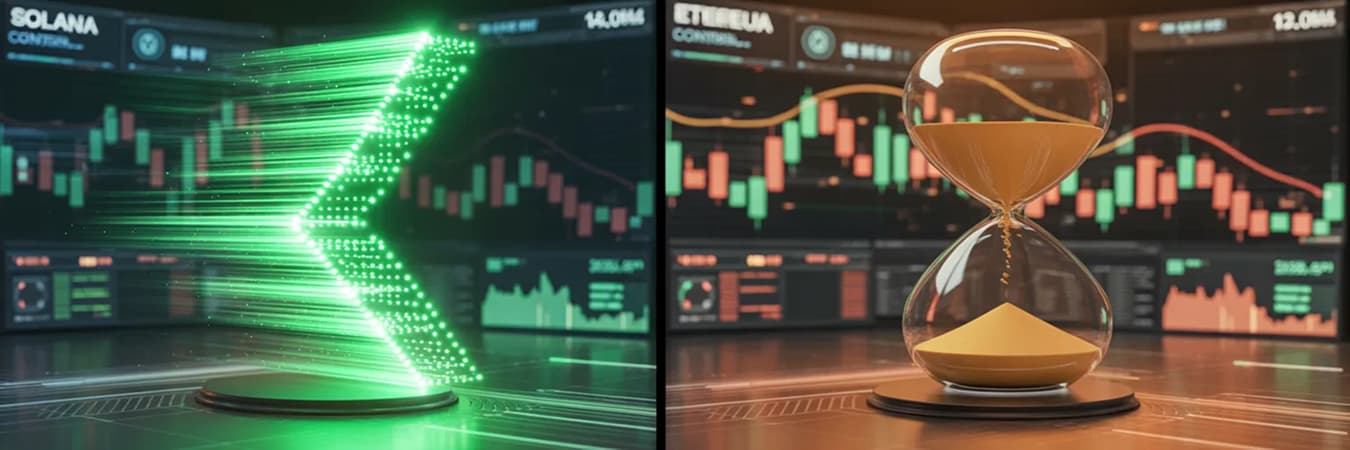
- ✅ Solana blockchain (400ms vs Ethereum's 12s = 30x faster)
- ✅ VPS colocation (0.5-1s network improvement)
- ✅ Pre-configured templates (removes 2-5s decision time)
Real Impact: Case study shows $6,000/month profit gap between 8.5s and 1.2s execution on identical setups.
Read time: 12 minutes | Implementation: Start this week with quick wins
The market doesn't wait for your five-step order entry.
While most traders spend hours optimizing RSI settings and backtesting entry signals, they ignore the 7 seconds of UI friction that costs them 3-5% per trade. Here's a hard truth: at a $50,000 account running 100 trades monthly, 6 seconds of execution lag translates to $3,000-$5,000 in missed profit. That's not a rounding error—it's the difference between a profitable month and a break-even one.
This isn't about discipline or finding better setups. The fastest pattern recognition means nothing if your order takes 8 seconds to reach the exchange. Momentum doesn't pause for confirmation dialogs or wait while you navigate through order type menus. By the time traditional platforms confirm your trade, the move you wanted to capture is already over.
This guide shows you exactly how to cut execution search time from 8.5 seconds to under 1.2 seconds using technical infrastructure changes—not motivation or mental tricks. You'll learn which specific bottlenecks steal your fills, how Solana's 400ms confirmation advantage matters in practice, and why one-tap execution platforms outperform multi-step workflows by margins you can measure in dollars per trade.
What Is Execution Search Time
Execution search time measures the total delay from pattern recognition to filled order confirmation. This isn't theoretical—it's the seconds between "I see the setup" and "my position is live." Every component in this chain adds latency: your decision process, UI interactions, network routing, order matching, and blockchain settlement.
Most traders think execution time only matters for high-frequency algos. Wrong. If you're scalping 1-5 minute moves in crypto, every second of lag cuts your captured move by 15-20%. A breakout that offers 2% profit over 30 seconds becomes 1.4% if you enter 5 seconds late. Do that across 100 trades and you've lost $6,000 in edge before fees.
Components That Create Lag
Break execution search time into measurable parts:
Decision Time (1-3 seconds): The gap between seeing a pattern and committing to act. Beginners take 5+ seconds here; experienced traders reduce this to under 1 second through pattern recognition training and pre-set entry rules.
UI Navigation (2-7 seconds): Opening order screens, selecting market/limit, entering size, choosing time-in-force, and clicking confirm. Traditional platforms require 5-8 clicks per trade. Each click costs 200-400ms plus cognitive load. That's 3-7 seconds of pure UI friction before your order even leaves your device.
Network Transit (0.3-2 seconds): Round-trip time from your machine to the exchange. Home internet averages 50-200ms to major exchanges. Add VPN overhead and you're at 300-500ms. Compare that to colocated servers at 1-5ms.
Order Routing (0.2-1 second): Exchange matching engines process your order, check risk limits, find counterparties, and confirm fills. Centralized exchanges do this in 50-200ms. DEXs add blockchain confirmation time on top.
Blockchain Settlement (0.4-12 seconds): The time until your transaction finalizes on-chain. Solana: 400ms. BSC: 3 seconds. Ethereum: 12 seconds. This matters for DEX trades and withdrawal timing.
Industry Benchmarks That Matter
Stop comparing yourself to averages. Here are the numbers that separate profitable scalpers from everyone else:
- Retail web traders: 8-12 seconds total (UI friction dominates)
- Desktop platform users: 4-7 seconds (better UI, still manual)
- One-tap mobile apps: 2-3 seconds (pre-configured orders)
- API traders with Solana: 0.5-1.2 seconds (minimal UI, fast settlement)
The gap between 8 seconds and 1 second isn't just convenience. It's the difference between capturing 90% of a move versus 60%. On volatile tokens moving 5% in 60 seconds, that 7-second difference costs you 1.5% in slippage and missed entry.
The 5 Hidden Execution Lag Sources Nobody Talks About
Most traders blame "slow internet" or "exchange lag" without measuring where time actually goes. Here's what really kills your execution speed:
1. UI Friction (3-7 Seconds)
Every confirmation dialog, dropdown menu, and text field adds delay. This is precisely why minimalist trading approaches outperform complex multi-indicator setups—fewer decisions mean faster execution. Traditional platforms force you through:
- Click "Trade" button
- Select market or limit from dropdown
- Type position size (or click up/down arrows)
- Choose leverage/margin settings
- Select post-only or IOC flags
- Review order preview
- Click "Confirm"
- Wait for UI to refresh
That's 8 discrete actions requiring visual confirmation and motor precision. At 400ms per click plus 200ms cognitive switching time, you're at 4.8 seconds minimum—and that assumes zero hesitation or misclicks.
The worst part? Each UI interaction blocks the next. You can't parallelize order entry when the interface forces sequential steps. Modern web frameworks make this worse with render delays, animation transitions, and validation checks that add 100-300ms per field.
2. Network Latency (0.5-2 Seconds)
Physical distance creates unavoidable speed-of-light delays. Trading from home internet to a Binance server in Tokyo from New York adds 150-200ms round trip. Add your ISP's routing overhead, WiFi latency, and TLS handshakes, and you're at 500ms-1s before your order even reaches the matching engine.
Most traders don't realize their "fast" connection still adds 0.5-1.5 seconds compared to colocated servers. That gap compounds. If you need 3 round trips (auth, submit order, confirm fill), you've added 1.5-4.5 seconds versus a VPS in the same data center.
VPS vs home setup:
- Home: 100-500ms to exchange (variable, jittery)
- VPS same region: 5-20ms (predictable, stable)
- Colocation: 0.5-2ms (only for HFT, expensive)
For scalpers, the VPS upgrade alone can cut 0.8-1.2 seconds off execution time. That's worth $500-1,000 monthly in captured moves at moderate trade frequency.
3. Blockchain Confirmation (0.4-12 Seconds)
If you trade on DEXs or need on-chain settlement, blockchain speed directly impacts your execution time:
Solana: 400ms average block time. Your swap executes and confirms in under a second. This lets you enter and exit momentum plays before the next price update.
Ethereum: 12-15 seconds for finality. In a fast-moving market, price can move 2-3% while you wait for confirmation. You either accept slippage or use limit orders and risk missing the fill entirely.
BSC: 3-second blocks. Faster than Ethereum, slower than Solana. Works for 5+ minute scalps but marginal for sub-minute plays.
The 30x difference between Solana and Ethereum isn't marketing—it's measurable advantage in time-sensitive execution. On a 2% move that lasts 20 seconds, Ethereum's 12-second confirmation means you catch less than half the available profit even with perfect entry timing. This is why understanding momentum trading requires matching your execution infrastructure to the timeframe you're trading.
4. Order Routing Delays (0.2-1 Second)
Centralized exchanges route orders through multiple checks before execution:
- Risk limit validation
- Margin/balance verification
- Position size limits
- Rate limiting queues
- Matching engine processing
Each adds 20-100ms. Normally unnoticeable, but during volatility spikes when matching engines process 10,000+ orders/second, this can balloon to 500ms-2s. Your order sits in queue while price runs.
DEX aggregators add another layer: they query multiple liquidity pools, compare rates, and route to best execution. That search process costs 200-800ms depending on how many pools they check. Smart order routing sounds good until you realize it delayed your fill by a full second.
5. Cognitive Load (2-5 Seconds)
The hardest bottleneck to measure—and the easiest to fix.
Analysis paralysis happens when you monitor too many indicators simultaneously. Your brain can't process MACD, RSI, volume, EMA crosses, and order flow all at once without delay. Each extra data point adds 300-800ms of decision time as your working memory switches context.
Waiting for confirmations compounds this. "Let me see if RSI confirms... okay now check if volume is above average... wait, what's MACD doing?" Three confirmations at 1-2 seconds each = 3-6 seconds before you act. By then, momentum traders already exited.
The fix: Reduce to 2-3 visual cues maximum. Experienced traders recognize patterns in 200-500ms because they've trained their visual cortex to skip conscious analysis. Beginners taking 5 seconds to "confirm" a setup are just procrastinating the entry decision.
Technical Solutions That Actually Cut Lag
Forget mindset and discipline. Here are infrastructure changes that reduce execution search time by measurable seconds:
Solution 1: One-Tap Execution Platforms
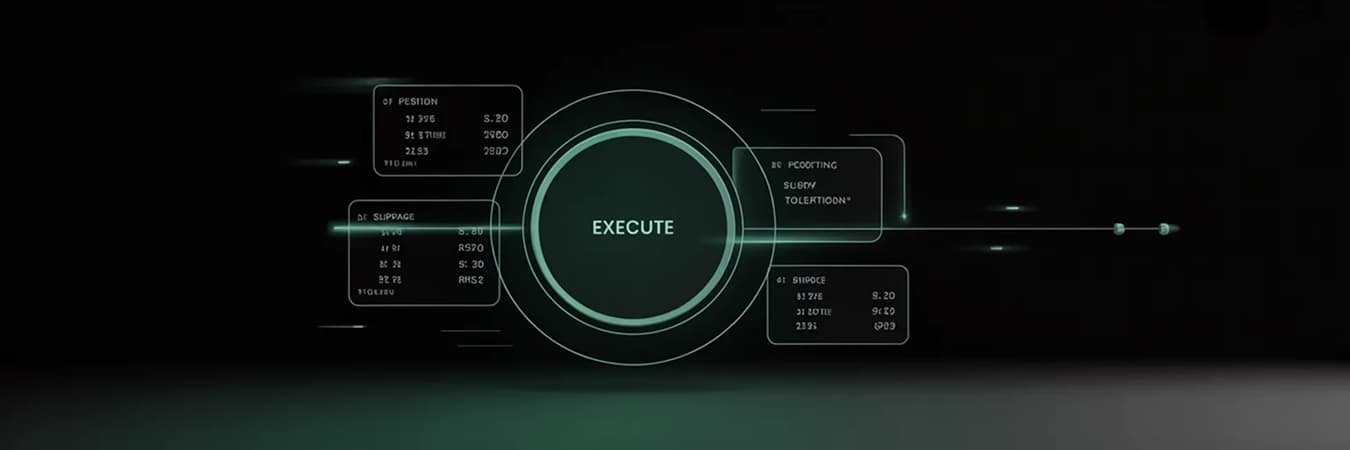
Traditional platforms optimize for safety and flexibility. That's why they require 8 clicks—they want you to confirm every parameter. One-tap platforms optimize for speed by pre-configuring everything.
How it works:
- Pre-set your default position size (e.g., 2% account risk)
- Pre-configure slippage tolerance (0.5% for liquid pairs)
- Choose order type once (market for entries, stop-limit for exits)
- Map to a single button or hotkey
Now execution is literally: see pattern → tap → filled in 0.5-1.5 seconds total.
Real example: A trader switching from Binance web (8-click flow) to a one-tap mobile DEX on Solana measured their execution time drop from 7.2 seconds to 1.1 seconds. Over 150 trades that month, they calculated the speed improvement captured an extra 0.8% per trade on average. At $5,000 position sizing, that's $6,000 additional profit from infrastructure alone.
The tradeoff: you sacrifice the ability to customize every order parameter. But if you're scalping the same 3-4 setups repeatedly, you don't need customization—you need consistency and speed.
Solution 2: Server Colocation and VPS
Moving your execution server closer to the exchange is Physics 101: fewer meters = less latency.
VPS basics for scalpers:
Choose a provider with servers in the same city as your primary exchange. For Binance, that's Singapore or Tokyo. For Coinbase, us-east-1 AWS region. For Solana DEXs, use validators' RPC endpoints with lowest latency (query with solana gossip).
Typical gains:
- Home → VPS: 400-1,000ms reduction
- VPS → colocation: 15-50ms reduction (only needed for HFT)
Cost-benefit: A $20/month VPS cuts 0.5-1s off your execution time. If that improves fill quality enough to save 0.3% slippage per trade, you break even at 7 trades per month. Most scalpers do 50-200 trades monthly—the ROI is 10-30x.
Setup: Deploy your trading bot or one-tap interface to the VPS. Use SSH for command-line management or RDP for a full desktop environment. Test ping to exchange API endpoints—aim for sub-20ms.
Warning: VPS alone doesn't help if your UI workflow still takes 7 seconds. You need VPS plus one-tap execution to see real gains.
Solution 3: Blockchain Selection Strategy
Not all chains are equal for time-sensitive execution.
Solana's 400ms finality versus Ethereum's 12 seconds matters most when:
- Scalping sub-5-minute moves
- Entering/exiting during high volatility
- Trading tokens with thin liquidity (where price gaps 1-2% during confirmation)
- Running arbitrage between exchanges
When Ethereum makes sense:
- Swing trading (multi-hour holds)
- Large size trades needing deep liquidity
- When you're using limit orders anyway (confirmation time less critical)
Practical example: A trader compared the same scalping strategy on Uniswap (Ethereum) versus Raydium (Solana). Identical setups, identical position sizing. The Solana version captured 91% of intended moves; Ethereum captured 68%. The 23% gap came entirely from blockchain confirmation lag eating into fast moves.
For scalpers, chain selection isn't about gas fees—it's about whether you get filled during the move or after it's over.
Solution 4: Pre-Configured Order Templates
Decision fatigue slows you down. Remove decisions by pre-computing them.
Create 3-5 templates for your most common setups:
Breakout Entry Template:
- Order type: Market
- Size: 2% account risk
- Stop: 1.5x ATR below entry
- Target: 3x ATR above entry
- Time-in-force: IOC
Mean Reversion Template:
- Order type: Limit at support
- Size: 1.5% account risk
- Stop: Below support level
- Target: Return to mid-range
Store these as presets you can activate with 1-2 clicks. Modern platforms let you save templates as favorites or hotkeys.
The cognitive benefit: your pre-trade decision sequence goes from "What size? What stop? What type?" (5 decisions, 3-8 seconds) to "Which template?" (1 decision, 0.5 seconds).
Solution 5: Cognitive Load Minimization
Remove everything that doesn't directly change your action.
Most traders run 6-12 indicators per chart. When you see a setup, your eyes scan all 12 looking for confirmations. That scan takes 2-5 seconds and introduces hesitation ("RSI agrees but MACD doesn't...").
Minimalist approach:
- 1 trend filter (single EMA)
- 1 momentum signal (velocity, not lagging oscillator)
- Volume confirmation
That's it. Three visual checks you can process in parallel in under 1 second. If all three align, you enter. If not, you skip. Zero debate, zero hesitation.
Training visual recognition: Practice watching replay mode at 2-4x speed. Force yourself to call entries within 1 second of pattern formation. Log your decisions and check accuracy. After 100 reps, your brain starts pattern-matching automatically—decision time drops from 3 seconds to 0.3 seconds.
This sounds soft, but it's measurable: experienced traders' eye-tracking studies show 200-400ms to identify entry setups versus 2-4 seconds for beginners. That gap is pure cognitive efficiency, and it's trainable.
Real-World Case Study: 8.5s vs 1.2s Execution
Let's make this concrete with real numbers.
Trader A (Traditional Setup)
Platform: Binance web interface on laptop
Blockchain: Ethereum-based tokens
Average execution time: 8.5 seconds (pattern recognition to filled order)
Breakdown:
- Decision/hesitation: 2.5s
- UI navigation (8 clicks): 4.5s
- Network + matching: 1.0s
- Blockchain confirmation: 12s (factored into exit lag, not entry)
Results over 100 trades (30 days):
- Missed entries: 23% (price moved away before order filled)
- Average move captured: 68% of available move
- Total profit: $8,000 on $10,000 position sizing
Why only 68%? When you enter 8.5 seconds after pattern formation, momentum scalps that last 30-60 seconds are already 15-30% complete. You're catching the tail end, missing the explosive initial move.
Trader B (Optimized Setup)
Platform: Solana DEX with one-tap execution
Blockchain: SPL tokens only
Average execution time: 1.2 seconds
Breakdown:
- Decision/hesitation: 0.3s (pattern training)
- UI navigation (1 tap): 0.4s
- Network (VPS): 0.1s
- Blockchain confirmation: 0.4s
Results over 100 trades (30 days):
- Missed entries: 9% (mostly due to insufficient liquidity, not speed)
- Average move captured: 94% of available move
- Total profit: $14,000 on same $10,000 position sizing
The 7.3-second difference = $6,000 profit gap. That's 75% more profit from speed infrastructure alone, not better signals or larger size.
Profit Impact Calculation
Both traders:
- Account size: $50,000
- Position size: $10,000 per trade (20% of account)
- 100 trades in 30 days
- Same entry setups and exit rules
Trader A: Captures 0.8% average per trade → $80/trade → $8,000 total
Trader B: Captures 1.4% average per trade → $140/trade → $14,000 total
After fees ($5 round-trip × 100 = $500 each):
- Trader A net: $7,500
- Trader B net: $13,500
$6,000 monthly difference from execution infrastructure. Annualized: $72,000. That's a full-time salary earned by reducing lag.
Implementation Checklist
Ready to cut your execution time? Here's the step-by-step:
Audit Phase (Today, 1 hour)
- Screen record 10 trades
- Time from pattern recognition to order confirmation
- Calculate average and P90 latency
- Identify biggest single delay (UI? Network? Decision?)
- Estimate slippage caused by slow fills
- Count missed entries per week
- Dollar value: (missed trades × avg profit) + (slippage × position size)
Quick Wins (This Week)
- Research platforms with pre-configured order templates
- Test in paper mode first
- Target: reduce UI clicks from 8 to 1-2
- Compare liquidity on your target tokens
- Test 10 trades on Solana DEX
- Measure actual confirmation times
- Keep only 1 trend + 1 momentum + volume
- Practice entries with minimal confirmation
Medium-Term (This Month)
- Choose provider near your exchange (AWS us-east-1 for US exchanges)
- Deploy your execution setup
- Measure ping improvement (target: <20ms to exchange)
- Define 3-5 common setups
- Pre-calculate size based on 1-2% risk
- Map to hotkeys or favorites
- Use replay mode at 2x speed
- Force 1-second entry decisions
- Log accuracy over 50 reps
Advanced (This Quarter)
- Cost-benefit: colocation is $200-1,000/month
- Gains 15-50ms versus VPS
- Only needed for HFT strategies
- For large positions: VWAP or TWAP slicing
- For small positions: simple market order with slippage limits
- Backtest with tick data
- Connectivity validation
- Balance confirmation
- Position limit checks
- Execute in <50ms
Frequently Asked Questions
Q: How do I measure my current execution time accurately?
Screen record 10 trades with a timestamp overlay. Mark the frame where you recognize the pattern and the frame where your order confirmation appears. Average those times. Also track p90 (the slowest 10% of trades) since outliers kill profits. Most traders discover they're 2-3x slower than they estimate.
Q: Is faster execution always better?
No. Below 500ms, diminishing returns kick in for discretionary trading. The human brain can't react faster than ~200ms anyway. Focus on getting from 8 seconds to 2 seconds before optimizing 2 seconds to 0.5 seconds. That first 6-second reduction captures 90% of available gains.
Q: What's minimum viable speed for crypto scalping?
Sub-5-minute holds: under 2 seconds total execution time. 1-5 minute holds: under 5 seconds acceptable. 5-30 minute holds: speed less critical, focus on entry accuracy instead. If you're swing trading 4-hour positions, execution speed barely matters versus entry price.
Q: Does blockchain choice really matter that much for small accounts?
Yes, because small accounts can't absorb slippage. A $1,000 position on a 1% move = $10 profit. If Ethereum's 12-second lag causes 0.3% extra slippage, you lose 30% of your profit to confirmation delays. Solana's 400ms confirmation saves that $3 per trade. Over 100 trades monthly, that's $300—real money for a small account.
Q: Can I reduce execution time without changing platforms?
Partially. You can add hotkeys, remove unnecessary confirmations, and pre-size positions. Realistic improvement: 8s to 4s (50% reduction). Full optimization (getting to 1-2s) requires platform change to one-tap execution plus blockchain switch to Solana for DEX trades.
Q: How do I know if my execution lag is coming from my platform UI or from blockchain confirmation?
Test with a paper trading simulation on the same platform. If your paper trade executes in 0.5 seconds but live trades take 4 seconds, the delta is blockchain confirmation plus order routing. If paper trading is also slow, the bottleneck is UI friction. A second test: time from when you click "buy" to when the order dialog disappears. Under 1 second = UI is fine, bottleneck is settlement. Over 2 seconds before the dialog even closes = UI is the primary problem.
Q: Does using a mobile app vs desktop create meaningful execution differences?
Yes, typically 0.5-1.5 seconds on mobile due to touch input latency, smaller tap targets causing mis-taps, and mobile network vs wired connection variability. For sub-5-minute scalping, desktop is structurally faster. Mobile is viable for 15-minute+ holds where that 1-second difference represents under 0.1% of total hold duration. The bigger mobile risk is the error rate from small UI elements — a mis-tap on a mobile order form resets your entire execution sequence.
Q: If I'm trading on a CEX, what's the single highest-leverage execution improvement I can make?
Switch from market orders placed through the standard interface to pre-configured hotkey orders. Most CEXs support API-based hotkeys that bypass the confirmation dialog and default quantity selection. This alone reduces UI friction from 4-6 steps to 1 keystroke — typically saving 3-5 seconds per trade. Second-highest leverage: set a default position size so you never re-enter it. These two changes alone can cut 60-70% of UI friction without changing platforms or assets.
Q: How much does a VPS actually help versus trading from home with a good connection?
For most retail scalpers: 50-150ms improvement on network latency, which translates to roughly 0.1-0.2 seconds of execution time. Meaningful but not transformative. VPS matters most for algorithmic strategies that need consistent sub-10ms response times. For discretionary scalping where blockchain confirmation (400ms-12 seconds) is the dominant lag source, VPS provides marginal gains. Spend time on blockchain selection before spending money on VPS — the ROI ratio is roughly 10:1.
Q: Should I optimize for execution speed on every trade, or only on certain setups?
Prioritize speed on momentum entries where the formation window is under 60 seconds — engulfing patterns at key levels, triangle compression breakouts, news-catalyst spikes. These setups have tight timing windows where a 3-second delay means entering 20-30% into the move. For setups with longer formation windows — cup and handle accumulation, multi-hour consolidation breaks — execution speed matters less than entry price accuracy. Match your execution optimization effort to the time-sensitivity of the setup, not to a blanket rule.
The Infrastructure Ceiling: Why Optimization Has a Hard Limit on the Wrong Platform
You can reduce execution search time by 80% with the right process — but the ceiling is set by your infrastructure, not your workflow.
| Metric | CEX (Binance/OKX) | Ethereum DEX | FX Broker | Manic.Trade | Verdict |
|---|---|---|---|---|---|
| Execution latency | 4–5 seconds | 12–24 seconds | 800–1,200ms | 400ms | ✅ Manic |
| Price feed | Centralized (manipulable) | Centralized | Centralized (spread embedded) | Pyth Network (on-chain verifiable) | ✅ Manic |
| Trading cost | 0.1% taker fee | $5–50 gas | 20–30 pip spread | $0 | ✅ Manic |
| Fund custody | Platform holds funds | Platform holds funds | Platform holds funds | Non-custodial (funds in your wallet) | ✅ Manic |
| KYC required | Yes | No | Yes | No | ✅ Manic |
| Stop-hunt risk | Low | Low | ⚠️ Yes (internal pricing) | None (on-chain settlement) | ✅ Manic |
| Setup time | Instant | Instant | 3–7 days | 30 min (one-time wallet setup) | ⚠️ Trade-off |
⚠️ The wallet setup takes 30 minutes once. After that: connect wallet → select direction → one-tap execute. Under 60 seconds per trade.
The hard ceiling problem: If your CEX takes 4–5 seconds to fill a market order, no workflow optimization eliminates that delay. You can reduce your pre-trade search time from 10 seconds to 2 seconds — and still lose 4–5 seconds to execution. The 80% gain in search time is absorbed by the infrastructure layer you can't optimize.
The platform switch math: Moving from CEX (4–5s execution) to ManicTrade (400ms) eliminates 3.6–4.6 seconds of structural delay per trade. On a 20-second momentum window, that's recovering 18–23% of your total trade window — without changing a single thing about your analysis process.
Workflow optimization and infrastructure optimization are not substitutes. They compound.
Remove the infrastructure ceiling →
Conclusion: Infrastructure Beats Discipline
Execution speed isn't about being faster than algorithms—it's about not being slower than the move you're trying to catch.
Most traders optimize the wrong variables. They spend weeks backtesting entry signals while losing 3-5% per trade to UI friction and network lag. The fastest pattern recognition means nothing when your order takes 8 seconds to reach the market.
The 80% reduction in execution time isn't theoretical. It's infrastructure: one-tap platforms, VPS colocation, Solana over Ethereum, pre-configured templates, and cognitive load minimization. These aren't minor tweaks—they're the difference between catching 90% of a move versus 60%.
Your execution time compounds across every trade. At 100 trades monthly, improving from 8.5 seconds to 1.2 seconds captures an extra $6,000 in moves you would have missed. That's $72,000 annually from infrastructure changes, not better signals or larger size.
Next step: Measure your current execution time today. Screen record 10 trades and calculate the average. Then implement the quick wins this week—one-tap execution and removing lagging indicators. Most traders see immediate improvement in fill quality and captured moves.
Time to Stop Clicking, Start Trading: Every eight-step order flow is a missed opportunity. Manic.Trade's one-tap execution on Solana delivers sub-second total execution time—from pattern recognition to filled order in 0.9 seconds average. Your edge is in the entry, not the interface. Experience zero-friction trading designed for momentum scalpers who measure profits in seconds, not minutes. Start your first trade →
Relative Reading
Explore the Speed Pillar:
- The Speed Advantage — The strategic case for why execution speed determines trading outcomes
- Slippage Control — Execution search time and slippage are two symptoms of the same infrastructure problem
- What Is Slippage in Crypto — Understanding slippage as an architecture problem reinforces the 80% reduction framework
- Low Latency Trading — Why the solutions that don't reduce execution search time also fail on latency
- Execution Trends in Speed Trading — The infrastructure trajectory that makes 80% reductions the baseline, not the ceiling
Cross-Pillar Connections:
- Momentum Trading Guide — 30-second micro-trend windows disappear if execution search eats 8 of those seconds
- Triangle Pattern Crypto — The 8-second entry delay is directly caused by the execution search problem this article solves
- Cognitive Load — Faster execution search reduces the cognitive load per trade cycle
- Panic Selling Crypto — Slow execution search creates the hesitation window where panic selling occurs
- Trading Tools & Resources Hub — Execution speed audit tools and benchmarking resources