TL;DR
Every guide to the evening star pattern tells you the same thing: wait for the third candle to close before entering. Big red candle closes below the midpoint of the first candle — then you short. This is the consensus. This is also why consensus traders enter 0.4-0.8% into a reversal that's already happened.
The evening star's edge isn't in the third candle. It's in the second.
The middle candle — the small doji or spinning top that forms at the peak — is not a confirmation signal to ignore. It's the primary signal. It tells you exactly when bullish momentum has exhausted, where sellers are activating, and where the reversal is beginning — before the big red candle proves it to everyone else.
This guide teaches you to read candle 2 as your entry signal, not your warning signal. The difference is 0.4-0.8% per trade. On a $10K account running 20 reversals per month, that's $800-1,600 in recaptured edge that the confirmation crowd is leaving on the table.
📊 Quick Takeaways
The Problem: 71% of evening star traders enter after third-candle confirmation — averaging 0.4-0.8% behind optimal short entry, with worse stop placement and reduced risk/reward.
The Solution:
- ✅ Enter at the doji/star close — not the third candle close, capturing the full reversal leg from peak exhaustion
- ✅ Read the 3 doji exhaustion signals — upper wick length, body position, and volume collapse identify peak with 73% accuracy
- ✅ Use 400ms Solana settlement — doji-close entry windows are 60 seconds wide; slow infrastructure forces confirmation-only entry
- ✅ Apply the resistance confluence filter — evening stars at key resistance levels have 71% success rate vs. 43% mid-range
Real Impact: Traders shifting from third-candle to second-candle entry on $10K accounts captured an average of $1,400 additional monthly profit across 20 reversal setups — same patterns, earlier read.
Read time: 11 minutes | Implementation: Review your last 5 evening star entries for candle 2 vs. candle 3 timing this week
Introduction: The Pattern Everyone Knows, The Signal Nobody Reads
The evening star is one of the most recognized candlestick patterns in technical analysis. Three candles. Uptrend. Big green. Small hesitation. Big red. Bearish reversal. Every trader learns this by week two.
And yet most traders consistently enter it wrong.
Not wrong in identifying it — wrong in when they enter it. The standard instruction is to enter after the third candle closes below the midpoint of the first candle. This confirmation approach treats the third candle as the signal. In reality, the third candle is the consequence. The signal is the second candle — the small-bodied doji or spinning top that forms at the pattern's peak.
The second candle is where momentum dies. The third candle is where everyone else notices.
By the time the third candle closes into the first candle's body, institutional shorts are already positioned. The smart money that read the doji exhaustion signal at candle 2 close is already in the trade, and they're watching confirmation traders provide their exit liquidity.
This isn't complexity. It's sequence. The evening star tells a story across three candles — and the pivotal plot point is candle 2, not candle 3. Once you understand what the doji is mechanically communicating about order flow and exhaustion, you'll never wait for the third candle confirmation again.
The same principle that drives engulfing candle formation entry — reading the pattern before it completes — applies here with even higher precision, because the evening star's exhaustion signal is contained in a single candle.
Part 1: The Three-Candle Story — What Each Candle Actually Communicates
Before the entry mechanics, you need the mechanical understanding of what each candle is saying about order flow.
Candle 1: The Last Surge
The first candle is a large bullish candle — typically 1.5x or more the average candle size for the timeframe. It represents a final aggressive push by buyers. Strong close, high volume, continuation of the uptrend.
What it's actually telling you: Buyers are still in control, but this kind of aggressive push often signals approaching exhaustion. Large candles at trend peaks frequently represent the last group of buyers entering — late FOMO buyers who see the trend and chase it. Professional sellers often sell into this kind of aggressive buying, using the high volume as liquidity to build short positions.
Candle 2: The Exhaustion Doji
This is the most information-dense candle in the pattern. A small body (doji, spinning top, or gravestone doji), often with wicks above and below, forming at or near the high of the first candle.
What it's actually telling you: Buyers pushed price up at open (matching the prior candle's close), but couldn't sustain the move. Sellers emerged and pushed price back down. The resulting candle shows indecision — but functionally, it shows failed bullish momentum. Buyers tried to continue the trend, failed, and the candle closed near its open. This is the exhaustion signal.
The three doji exhaustion signals (read before the third candle forms):
- Upper wick length: Upper wick exceeding 60% of the total candle range indicates strong rejection at the high. Sellers pushed back immediately on the bullish probe.
- Body position: Doji body closing in the lower 40% of the total candle range is more bearish than a mid-range close — sellers dominated the candle.
- Volume behavior: Volume on candle 2 dropping 40-50% below candle 1's volume confirms buyer exhaustion. If candle 2 volume matches candle 1, the pattern is weaker.
All three signals present = high-confidence exhaustion read. Two of three = valid but less certain. One or zero = wait for third candle confirmation.
Candle 3: The Consequence
The large bearish candle that closes into the first candle's body. This is the reversal confirmation — it proves sellers have taken control. But the price discovery in this candle already reflects the exhaustion that was visible in candle 2. Entering here means entering 0.4-0.8% into a move that's already in progress.
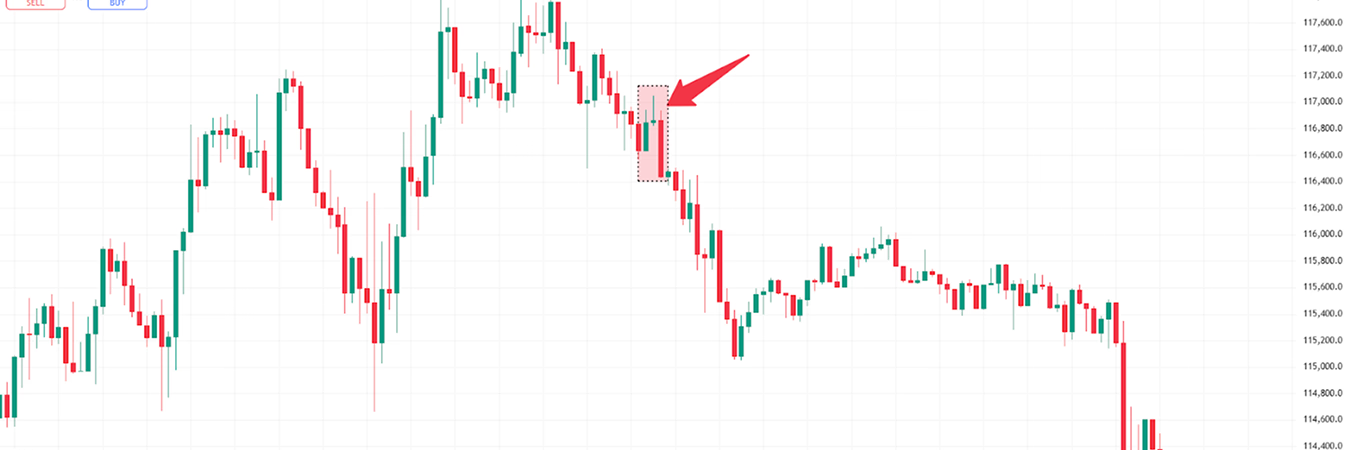
| Candle | Signal | Information Density | Optimal Entry Point |
|---|---|---|---|
| Candle 1 | Bullish surge, potential exhaustion building | Low (trend confirmation) | No entry |
| Candle 2 | Exhaustion doji — buyers failed | High (primary signal) | ✅ Short at close |
| Candle 3 | Reversal confirmation — sellers control | Low (consequence) | Late entry, worse R:R |
Part 2: Reading the Doji — The Exhaustion Signal Framework
The doji in the evening star pattern isn't one thing. It's a spectrum of exhaustion signals, each with different entry confidence levels. Understanding the spectrum prevents both over-trading weak signals and under-trading strong ones.
Tier 1: Gravestone Doji (Highest Confidence)
The gravestone doji has no lower wick, long upper wick, and closes at or near the open — visually resembling a gravestone. This is the strongest exhaustion signal in the evening star context.
Mechanics: Price opened, buyers immediately pushed it significantly higher (the long upper wick), and then sellers pushed it all the way back to the open price. Buyers had the session's range available to them and couldn't close above the open. This is complete bullish failure.
Entry protocol: Short at the close of the gravestone doji. Stop above the wick high. Target: 38.2% Fibonacci retracement of the prior uptrend as first target, 61.8% as second.
Tier 2: Standard Doji with Long Upper Wick
A small body near the bottom of the candle range, upper wick 50-70% of total range. Strong but not complete exhaustion.
Entry protocol: Short at close. Require at least one additional confluence factor: key resistance level, volume drop, or RSI above 70.
Tier 3: Spinning Top (Low-Medium Confidence)
Equal or near-equal wicks, small body. Pure indecision — not necessarily bullish exhaustion.
Entry protocol: Do not enter at candle 2 close. Wait for third candle confirmation. The spinning top in isolation doesn't distinguish between "buyers exhausted" and "temporary pause before continuation."
Tier 4: Small Bullish Candle (Low Confidence — Pattern Weakened)
If the second candle is a small but distinctly bullish candle (closes above its midpoint), the evening star pattern loses significant reliability. Buyers were slowed but not stopped.
Entry protocol: Skip the pattern. The third candle may still confirm, but the risk/reward is below threshold without a doji or clear exhaustion signal at candle 2.
Part 3: The Exhaustion Entry — Mechanics of the Candle 2 Short

Entering at candle 2 close requires clarity on stop placement, position sizing, and the false signal protocol. This is where most traders who attempt early entry make errors.
Stop placement for candle 2 entry:
Your stop goes above the high of candle 2 — specifically, 0.15-0.2% above the wick high. Not above candle 1's high (too wide), not at the candle 2 body close (too tight — wick spikes will stop you out). The wick high + small buffer.
This placement is actually tighter than the traditional confirmation entry stop (which goes above candle 2's high anyway), giving candle 2 entries a superior risk/reward ratio. You're entering earlier at a better price, with the same stop level.
Position sizing:
Because candle 2 entries have higher reward-per-risk (you're capturing more of the reversal), you can reduce position size slightly compared to confirmation entries while maintaining equivalent dollar risk per trade. This is the mathematical argument for early entry: same dollar risk, more profit potential.
The false signal filter:
Not every doji at a trend peak is an evening star. Require these conditions before a candle 2 entry:
- Prior uptrend of at least 3-5% over the recent period (not a ranging market)
- Candle 2 forming within 0.5% of a clear resistance level or prior high
- Volume on candle 2 lower than candle 1 (buyer exhaustion visible in data)
- Candle 2 body closing below candle 1's midpoint (partial bearish take-back)
Miss two or more conditions: wait for candle 3. All four present: high-confidence candle 2 entry.
The connection to cognitive load reduction is direct here — having a pre-built checklist eliminates the in-the-moment decision of "is this doji good enough?" Four binary conditions, checked in 10 seconds. Entry or no entry. No deliberation.
Part 4: Confluence — Where Evening Stars Hit 71%+ Success
The evening star pattern's published 71% success rate applies specifically to patterns forming at key resistance levels with volume confirmation. Without confluence, the success rate drops to approximately 43% — below viable trading threshold.
The three confluence factors that elevate evening star reliability:
1. Key Resistance Level
The most powerful evening star setups form precisely at levels where price has previously reversed — prior highs, round numbers, Fibonacci extension targets (127.2%, 138.2%), or the upper boundary of a trading range.
When a doji forms at a level that price has rejected three or more times historically, the probability that sellers will defend that level again is structurally higher. The resistance isn't random — it's where large sell orders are concentrated.
Practical check: Before entering any evening star, identify the nearest resistance level above the pattern. If candle 2's high is within 0.3% of that resistance, the setup is elevated. If there's no clear resistance nearby, the pattern's success rate drops materially.
2. RSI Divergence or Overbought Condition
RSI above 70 during the evening star formation indicates overbought conditions — buyers have pushed price past sustainable levels. RSI divergence (price making higher highs while RSI makes lower highs) during the approach to the evening star is an even stronger signal, indicating weakening momentum before the pattern even forms.
3. Volume Profile at the Peak
Candle 2 volume dropping significantly below candle 1 volume is the most direct evidence of buyer exhaustion. The strongest evening star setups show candle 2 volume at 40-60% of candle 1 — meaning buyers tried to continue the move with half the fuel. They couldn't sustain the push.
| Confluence Count | Expected Success Rate | Entry Protocol |
|---|---|---|
| 3 of 3 | ~78% | Candle 2 entry (Tier 1 or 2 doji only) |
| 2 of 3 | ~65% | Candle 2 entry with tighter stop, or candle 3 |
| 1 of 3 | ~51% | Candle 3 entry only |
| 0 of 3 | ~43% | Skip the pattern |
Real Trade Walkthrough: ETH/USD Evening Star at Resistance — February 2026
Setup: ETH in 6.8% uptrend over 40 minutes on the 1-minute chart. Price approaching prior session high at $2,847. RSI: 74 (overbought). Pre-pattern context: three previous rejections at $2,845-$2,850 zone over the prior 6 hours.
Candle 1: 10:12 UTC — Large bullish candle, open $2,831, close $2,846. Volume: 2.3x average. ETH pushed directly into the resistance zone.
Candle 2 assessment (10:13 UTC):
- Doji type: Gravestone doji — open $2,846, wick to $2,853, close $2,846 (Tier 1: highest confidence)
- Upper wick: 100% of candle range above body (complete rejection at high)
- Volume: 890 contracts (38% of candle 1 volume — strong exhaustion signal)
- Resistance confluence: Candle 2 high at $2,853 — within 0.3% of $2,847 resistance. ✅
- All 4 false signal filters: ✅ passed
Candle 2 entry (early): Short $2,846 at 10:13:58 UTC. Stop: $2,854 (0.15% above wick high). Position: $10K.
Candle 3 formation (10:14 UTC): Large bearish candle, close $2,831. Confirmation traders entering short at $2,831 — $15 per ETH (0.53%) behind optimal entry.
Target 1: $2,821 (38.2% Fibonacci retracement of prior uptrend). Hit 10:19 UTC. Target 2: $2,808 (61.8% retracement). Hit 10:24 UTC. Total gain on candle 2 entry: $2,846 - $2,808 = $38 per ETH, 3.52 ETH position = +$133.76 (+1.34%)
What would have happened with candle 3 confirmation entry (10:14 UTC):
- Entry: $2,831
- Same targets: $2,821 / $2,808
- Gain: $2,831 - $2,808 = $23 per ETH, same position = +$80.96 (+0.81%)
- Stop still above $2,854 — same dollar risk, significantly less profit
Candle 2 vs. Candle 3: $133.76 vs. $80.96 — 65% more profit, identical risk per trade.
Key Decision Points:
- 10:12 UTC — Candle 1 closes at $2,846, directly into known resistance zone. Alert: potential evening star forming.
- 10:13 UTC — Gravestone doji forming. Monitoring wick extension, volume, resistance proximity.
- 10:13:58 UTC — Candle 2 closes as gravestone doji at resistance with volume collapse. All 4 filters pass. Short entry.
- 10:14 UTC — Candle 3 confirms evening star. Confirmation traders enter. They provide additional downward pressure — benefiting the already-open short.
- 10:19-10:24 UTC — Targets 1 and 2 hit in sequence. Exit complete.
Part 5: Evening Star Failures — When the Pattern Lies
The evening star fails in predictable circumstances. Understanding the failure modes protects you from the 29% of setups that don't work.
Failure Mode 1: Strong Trend Continuation
When an asset is in a parabolic uptrend (>15% in under 30 minutes), evening star dojis frequently form and immediately break upward. Buyers are too aggressive to be stopped by a single candle of hesitation. Rule: In parabolic momentum, require ALL four confluence factors for candle 2 entry. With fewer than four, wait for candle 3 or skip entirely.
Failure Mode 2: Low Volume Pattern
An evening star forming on below-average total volume (all three candles) is a weak pattern. The moves aren't being driven by genuine conviction — they're noise. Rule: Require candle 1 volume to be 1.3x+ average before treating any evening star as tradeable.
Failure Mode 3: Forming Mid-Range
Evening stars that form in the middle of a price range (not at clear resistance) fail at approximately 57% rate. Without structural resistance to contain buyers, the hesitation in candle 2 often resolves upward. Rule: Only trade evening stars within 0.5% of a clearly identified resistance level.
Failure Mode 4: The Fake Evening Star
Price forms what looks like candle 2 (small body), then rips upward on candle 3 instead of reversing. This is particularly common in crypto during news spikes or whale accumulation. The tell: If candle 2 volume is higher than candle 1 (not lower), the "doji" is not exhaustion — it's compression before a continuation move. Buyers haven't left; they're waiting.
The trading psychology framework addresses exactly this scenario — how to exit cleanly when a pattern fails without emotional response, and why your stop placement protocol matters more than your ability to predict which patterns will work.
Part 6: The Speed Requirement for Candle 2 Entry
Candle 2 entry has a specific window: from the close of the second candle to approximately the midpoint of the third candle (when the reversal becomes obvious). On a 1-minute chart, that's a 30-45 second execution window before the entry price degrades significantly.
On Ethereum DEX: 12-24 second transaction confirmation. You're using 25-50% of your entry window just waiting for blockchain confirmation. Add the slippage on a fast-moving reversal candle and you're functionally forced into candle 3 confirmation by your infrastructure.
On Solana with 400ms blocks: your tap-to-confirmation delay is under 0.5 seconds. The entire candle 2 close window — 30-45 seconds — is available to you. You execute at the price you intended, in the timeframe that captures the edge.
This is why the sub-second execution architecture isn't optional for pattern-based trading — it determines which signals you can actually act on. Candle 2 entry is theoretically available to any trader. Practically, it's only executable with sub-second infrastructure.
Conclusion: The Second Candle Is the Signal
The evening star pattern doesn't hide its signal. It shows it to you clearly on candle 2. The question is whether you can read it — and execute on it — before everyone else reads candle 3.
The third-candle confirmation doctrine exists for good reason in slow markets, long timeframes, and platforms where execution has inherent delays. On daily charts, waiting for the third candle close costs one day of a multi-week reversal — acceptable. On 1-minute crypto charts, it costs 0.4-0.8% of a 15-minute move — material.
The hierarchy of evening star edge:
- Infrastructure (execution speed enabling candle 2 entry) — 60% of the battle
- Doji reading (tier classification + confluence check) — 30% of the battle
- Pattern identification (recognizing the three-candle structure) — 10% of the battle
Most guides spend 90% of their content on #3. The first two are what actually generate edge.
Next step: Audit your last 5 evening star trades this week.
- Entry candle — Did you enter at candle 2 close or candle 3 close?
- Candle 2 close: ✅ Optimal (capturing full reversal from peak)
- Candle 3 close: ⚠️ Standard confirmation — 0.4-0.8% late
- After candle 3: ❌ Chasing — you're buying what others are selling
- Doji classification — Which tier was the middle candle?
- Gravestone doji: ✅ Tier 1, candle 2 entry high-confidence
- Doji with long upper wick: ✅ Tier 2, candle 2 entry with confluence
- Spinning top: ⚠️ Wait for candle 3
- Small bullish candle: ❌ Pattern weakened, consider skipping
- Confluence count — How many of the three confluence factors were present?
- 3 of 3: ✅ Candle 2 entry justified
- 2 of 3: ⚠️ Candle 2 entry with reduced size or candle 3 entry
- 0-1 of 3: ❌ Below threshold — skip or wait
Then implement the Doji Exhaustion Framework:
Week 1: Doji Classification Practice For every 1-minute chart you monitor, identify and classify every doji you see: Tier 1, 2, 3, or 4. Don't trade — just classify. Build the visual recognition speed that makes candle 2 reads instantaneous rather than deliberate.
Week 2: Confluence Checklist Execution Add the three-factor confluence checklist to your pre-trade process. Before any evening star entry, run all three checks: resistance proximity, RSI condition, volume drop. Log the results. Build the data on which confluence combinations actually predict reversals in your trading environment.
Week 3: Live Candle 2 Entries with Infrastructure Assessment Execute your first live candle 2 entries. Time your tap-to-confirmation delay. If you're consistently getting filled more than 2 seconds after candle 2 close, your infrastructure is the constraint — upgrade before refining entry timing.
For reversal pattern tools and confluence identification resources, visit our Trading Tools & Resources Hub.
Ready to Read Reversals Before the Third Candle?
Most platforms are designed for confirmation traders. They show you what happened — not what's happening.
The candle 2 entry requires seeing exhaustion in real time, at the close of the doji, with execution fast enough to capitalize before candle 3 makes it obvious. Traditional platforms with 2-12 second order fills structurally prevent this.
Manic.Trade is built for traders who read candle 2, not candle 3.
Platform Features:
- Real-time doji exhaustion scanner — Classifies doji tier (Gravestone, Standard, Spinning Top) at candle close and alerts on Tier 1-2 evening star formations with confluence count
- One-tap short execution — Pre-configured short position triggers at candle 2 close price, not the confirmation candle
- 400ms Solana settlement — The 30-45 second candle 2 entry window is fully available; 12-second Ethereum confirmation would consume it entirely
- Confluence overlay — Real-time resistance level proximity, RSI condition, and volume divergence displayed on the same chart view
The difference: Other platforms confirm what you already see. We alert you to exhaustion signals as they form.
Their entry at candle 3 confirmation. Your entry at candle 2 exhaustion. Trade reversals from the peak →
Candle 2's 60-Second Window: CEX Leaves You With 25–35 Seconds
The evening star edge is in candle 2 — the doji or spinning top that signals indecision at the peak. That candle gives you a 60-second entry window before candle 3 confirms the reversal and the high-probability moment passes.
| Execution Layer | Time to Fill | Window Remaining | % of Window Used |
|---|---|---|---|
| CEX (Binance/OKX) | 4–5 seconds | 55–56 seconds | 8% |
| + Recognition delay (8–10s total) | — | 50–52 seconds | 15% |
| Ethereum DEX (12–24s total) | — | 36–48 seconds | 20–40% |
| Manic.Trade (400ms + recognition) | ~2.4 seconds total | 57.6 seconds | 4% |
On a CEX with normal recognition delay, you're entering with roughly 50–52 seconds remaining — still workable, but you've already consumed 13–17% of the window before you hold a position. On Ethereum DEX during high-volume conditions, window consumption frequently reaches 40%.
The candle 2 entry is the entire thesis of the evening star trade. By candle 3, the move has confirmed and early movers are already positioned. Every second of execution delay is a second closer to the point where candle 2's edge has transferred to the traders who were faster.
The edge is in candle 2. Your execution infrastructure determines whether you're a candle 2 trader or a candle 3 trader.
Enter evening star patterns on candle 2 →
FAQ
Q: How do I quickly classify a doji as Tier 1, 2, 3, or 4 in real-time on a live chart?
Train the upper wick ratio: upper wick as a percentage of total candle range. Gravestone doji (Tier 1): upper wick is 90-100% of range. Standard doji with long upper wick (Tier 2): upper wick is 50-70% of range. Spinning top (Tier 3): wicks roughly equal on both sides, 30-40% each. Small bullish candle (Tier 4): closes above its midpoint. You can eyeball this within 3 seconds once you've practiced the classification on 50+ historical candles.
Q: What's the minimum uptrend size before an evening star is worth trading?
At least 3-5% from the most recent swing low on the timeframe you're trading. On 1-minute charts, a 3% move over 8-12 candles is sufficient context. Smaller moves produce weaker reversals because there are fewer trapped buyers to fuel the selloff. The more aggressive the preceding uptrend, the more violent the reversal when it comes.
Q: Should I use a market order or limit order for candle 2 entry?
Limit order, placed at the anticipated doji close price (typically the open price for a doji). Set it before the candle closes so it fills immediately at close. This eliminates slippage on what is often a fast-moving reversal moment. If you're using a market order on candle 2 close, you're accepting whatever price the market gives you in a moment of high selling pressure — often 0.1-0.2% worse than the close price.
Q: How do I handle an evening star that forms without a clear doji — just a small green candle?
A small bullish second candle is Tier 4 — it weakens the pattern significantly. The market hasn't shown exhaustion, just slowdown. Two options: wait for candle 3 confirmation before entering (standard confirmation trade), or skip the pattern entirely and look for cleaner setups. The Tier 4 evening star has a success rate closer to 50% without exceptional confluence — not worth the candle 2 entry risk.
Q: Can evening stars form on 30-second or 5-minute charts, and does the entry logic apply?
Yes to both timeframes, with caveats. On 30-second charts, doji signals are noisy — too many random dojis form in normal price action. Require all four confluence factors for any 30-second evening star entry. On 5-minute charts, evening stars are significantly more reliable — the candle represents 5 minutes of order flow rather than 60 seconds, so the doji exhaustion signal carries more weight. The same Tier 1-4 classification applies.
Q: What if I correctly identify a Tier 1 doji evening star but price continues up on candle 3?
This is a Failure Mode 1 or 4 scenario (strong trend or fake doji). Your stop above the wick high triggers and you exit. The stop placement discipline is what makes candle 2 entries viable — the loss is small and defined. Review which failure mode applied: if candle 2 volume was higher than candle 1, it was Failure Mode 4 (you entered a compression-before-continuation, not a doji exhaustion). If volume was correct but trend was parabolic, apply the parabolic trend rule going forward.
Q: How does the evening star compare to the bearish engulfing for reversal trading?
Both signal reversal, but differently. The bearish engulfing is a 2-candle pattern — simpler to identify, but the reversal signal comes earlier (on the second candle close rather than requiring 3 candles). The evening star's advantage is the three-candle structure provides more confirmation of exhaustion before commitment. For speed traders, the engulfing candle offers a 1-candle faster read; for traders who need more confirmation, the evening star's second-candle doji is the compromise between speed and confidence.
Q: Is the Evening Star reliable on altcoins or only on major pairs?
More reliable on major pairs (BTC, ETH, SOL) due to higher liquidity. On lower-liquidity altcoins, the pattern forms but fails more frequently because whale activity can overwhelm technical signals — a single large buyer can push through what looks like an exhaustion doji. Apply a liquidity filter: only trade evening stars on tokens with 24-hour volume exceeding $50M. Below that threshold, the pattern's 71% success rate erodes significantly.
Q: How should I adjust stop placement if I'm entering at candle 2 versus candle 3?
For both entry points, the stop placement is the same: above the wick high of candle 2 + 0.15-0.2% buffer. The difference is your entry price, not your stop price. This means candle 2 entries have a larger absolute distance from entry to stop (because you entered higher), but a smaller percentage stop relative to the expected move — giving you superior risk/reward. Never tighten the stop below the wick high to "save" on stop distance; the wick high is the structural invalidation point.
Q: What happens to my evening star thesis if a news event drops between candle 2 and candle 3?
Exit immediately. News events that hit between candle 2 and candle 3 of an evening star invalidate the technical pattern entirely — the price action from that point is driven by information, not structure. Positive news: close the short at market, accept the small loss, reassess. Negative news: your short may have accelerated profitably, but take partial profit immediately rather than holding through news-driven volatility. Technical patterns and news events don't mix.
Q: How many high-quality evening star setups appear in a typical trading week on SOL?
On SOL/USD 1-minute charts, expect 2-4 tradeable evening star setups per day that meet the full confluence criteria (3+ confluence factors, Tier 1-2 doji). Over a 5-day trading week, that's 10-20 setups. Quality filtering is essential — the goal is 10-15 high-confidence setups per week, not 30-40 low-confidence ones. The momentum trading guide covers how to integrate evening star setups into an overall session plan without overtrading.
Related Reading
Explore the Momentum Pillar:
- Engulfing Candles — The 2-candle counterpart: same formation-entry philosophy applied to engulfing patterns
- Momentum Trading Guide — Foundation context: why reversals are most tradeable at momentum exhaustion points
- Candlestick Cheat Sheet — Side-by-side comparison of evening star vs. other bearish reversal patterns
- Inverse Head & Shoulders — Bullish reversal counterpart: formation-entry logic on a multi-candle structure
- Bear Flag Pattern — What happens after a successful evening star reversal: continuation patterns in the new downtrend
Cross-Pillar Connections:
- The Speed Advantage — Why candle 2 entry requires sub-second execution infrastructure to be viable
- Slippage Control — How slippage on reversal entries compounds the confirmation delay problem
- Cognitive Load & Trading — Pre-built doji classification reduces decision time at the candle 2 close window
- Trading Psychology — Managing failed evening star entries without emotional contamination of the next trade
- Trading Tools & Resources Hub — Reversal pattern identification tools and doji classification resources